Showing posts with label Caboose. Show all posts

Saturday, June 27, 2026

Canby Depot Museum

Canby Depot Museum in Canby, Oregon, on May 11, 2007

The railroad depot in Canby, Oregon, was originally built in 1873 by the Oregon & California Railroad and was originally located at North First and Grant Streets. It is the oldest railroad depot in Oregon. The railroad was taken over by the Southern Pacific in 1887.

Canby Depot Museum in Canby, Oregon, on May 11, 2007

Additions were made to the depot in 1891 and 1907. The depot closed on August 4, 1976, and in 1978 the Southern Pacific Railroad offered the building to the people of Canby with the provision that it be moved off railroad property.

Canby Depot Museum in Canby, Oregon, on May 11, 2007

The building was moved to its current location on August 4, 1983, and the 1907 addition was removed so its materials could be used to restore the rest of the building.

Canby Depot Museum in Canby, Oregon, on May 11, 2007

The Canby Depot Museum opened on October 6, 1984. It is home to the Canby Historical Society.

Canby Depot Museum in Canby, Oregon, on May 11, 2007

Several other railroad artifacts are here as well including signals, a speeder shed and a caboose.

Union Pacific Caboose #25584 at the Canby Depot Museum in Canby, Oregon, on May 11, 2007

This caboose at the Canby Depot Museum was originally Union Pacific #25584.

Union Pacific Caboose #25584 at the Canby Depot Museum in Canby, Oregon, on May 11, 2007

This is one of 100 class CA-8 cabooses that were built for the Union Pacific by the International Car Company of Kenton, Ohio. 

Union Pacific Caboose #25584 at the Canby Depot Museum in Canby, Oregon, on May 11, 2007

Union Pacific caboose #25584 was built in November 1964. 

Union Pacific Caboose #25584 at the Canby Depot Museum in Canby, Oregon, on May 11, 2007

It was retired from service by Union Pacific on April 4, 1988.

Union Pacific Caboose #25584 at the Canby Depot Museum in Canby, Oregon, on May 11, 2007
 
The Canby Depot Museum acquired this caboose in August 1989.

Union Pacific Caboose #25584 at the Canby Depot Museum in Canby, Oregon, on May 11, 2007

Though it is a former Union Pacific caboose, it has been repainted in the colors worn by Southern Pacific cabooses, and wears the Southern Pacific's "Sunset" herald.

Union Pacific Caboose #25584 at the Canby Depot Museum in Canby, Oregon, on May 11, 2007

The interior of the caboose is largely intact, though much of the space is now occupied by display cases for museum artifacts.

Union Pacific Caboose #25584 at the Canby Depot Museum in Canby, Oregon, on May 11, 2007

The museum was not open when I stopped by late in the afternoon on May 11, 2007, so I wasn't able to go inside the caboose or get a good look at the museum displays.

Union Pacific Caboose #25584 at the Canby Depot Museum in Canby, Oregon, on May 11, 2007

I was only able to look in the windows from the platforms at each end.

Union Pacific Caboose #25584 at the Canby Depot Museum in Canby, Oregon, on May 11, 2007

While there are no traces of the caboose's original identity on the exterior, its original number can still be seen on the inside.

Southern Pacific Concrete Telephone Booth at the Canby Depot Museum in Canby, Oregon, on May 11, 2007

Southern Pacific adopted this standard design of concrete telephone booth in June 1922. These phone booths were built by the railroad and weighed about 3,000 pounds. They contained a telephone that connected directly to a railroad dispatcher, allowing train crews, track workers, and signal maintainers a way to communicate before radios became available and made these booths obsolete in the early 1980s.
 
Railroad Shed at the Canby Depot Museum in Canby, Oregon, on May 11, 2007

Another railroad structure at the Canby Depot Museum is this shed, which was originally used to house a handcar or "speeder" motorcar for use by track maintenance of way personnel.

Magnetic Flagman "Wig-Wag" Crossing Signal at the Canby Depot Museum in Canby, Oregon, on May 11, 2007

The "Magnetic Flagman "Wig-Wag" crossing signal was a common grade crossing signal before the modern crossbuck became a standard and flashing lights and gates were mandated. It takes its name from the movement it makes; the black and white banner with the red light in the middle swings, or "wig-wags" back and forth simulating that a human flagman would make with a flag or lantern to stop traffic. The signal also features a bell. 

Magnetic Flagman "Wig-Wag" Crossing Signal at the Canby Depot Museum in Canby, Oregon, on May 11, 2007

This type of signal was manufactured by the Magnetic Signal Company of Los Angeles, California from 1910 to 1949. There were several versions of wig-wag made; this is a Model 3 lower-quadrant signal, which was the most common in Oregon and was widely used by the Southern Pacific Railroad. 

Magnetic Flagman "Wig-Wag" Crossing Signal at the Canby Depot Museum in Canby, Oregon, on May 11, 2007

There were a number of these signals remaining in service into the 2000s, but in 2006, after receiving federal funding, the State of Oregon announced plans to replace the remaining wig-wags on freight lines, and by 2008 most if not all had been removed, leaving only two (now one) on the Willamette Shore Trolley line plus those on static display or in museums like this one.

Artifacts at the Canby Depot Museum in Canby, Oregon, on May 11, 2007

Assorted museum artifacts were scattered on the platform of the depot.

Switch Stand at the Canby Depot Museum in Canby, Oregon, on May 11, 2007

Another railroad artifact at the Canby Depot Museum is this switch stand.

Semaphore Signal at the Canby Depot Museum in Canby, Oregon, on May 11, 2007

This lower-quadrant semaphore signal was built by The Union Switch & Signal Company of Swissvale, Pennsylvania, near Pittsburgh. Union Switch & Signal was founded by George Westinghouse in 1881 and survived under that name until being renamed Anasldo STS - USA in January 2009.

Saturday, June 1, 2024

Trains in Lebanon, Oregon, on March 3, 2006

Albany & Eastern GP38-3 #2001 at Lebanon, Oregon, on March 3, 2006
 
I took these pictures on the Albany & Eastern Railroad near the depot in Lebanon, Oregon, on March 3, 2006.

Albany & Eastern GP38-3 #2001 at Lebanon, Oregon, on March 3, 2006

Albany & Eastern #2001 was built by the Electro-Motive Division of General Motors in February 1970 as Illinois Central #9502, one of an order of 20 2,000-horsepower GP38AC locomotives.

Albany & Eastern GP38-3 #2001 at Lebanon, Oregon, on March 3, 2006

In 1972, the Illinois Central merged with the Gulf, Mobile & Ohio to become the Illinois Central Gulf, and the locomotive became Illinois Central Gulf #9502.

Albany & Eastern GP38-3 #2001 at Lebanon, Oregon, on March 3, 2006

After their original 15-year lease expired, this was one of 18 of the 20 to be leased to the Missouri-Kansas-Texas in 1985, and it became MKT #327.

Albany & Eastern GP38-3 #2001 at Lebanon, Oregon, on March 3, 2006

The Missouri-Kansas-Texas was acquired by the Union Pacific, and the locomotive became Union Pacific #1984 on February 6, 1991.

Albany & Eastern GP38-3 #2001 at Lebanon, Oregon, on March 3, 2006

After the MKT lease expired, Union Pacific purchased it on October 23, 1996.

Albany & Eastern GP38-3 #2001 at Lebanon, Oregon, on March 3, 2006

It was renumbered to Union Pacific #1785 on August 27, 1997.

Albany & Eastern GP38-3 #2001 at Lebanon, Oregon, on March 3, 2006

It was assigned Union Pacific #285 in December 1999, but was retired by Union Pacific on May 25, 2001, before being renumbered. In 2002 it came to the Albany & Eastern as GP38-3 #2001.

Southern Pacific Caboose #4716 at Lebanon, Oregon, on March 3, 2006

Southern Pacific #4716 is a C-50-9 Bay-Window Caboose that was built by PACCAR in 1980 as part of an order of 75 that would be Southern Pacific’s last new cabooses.

Southern Pacific Caboose #4716 at Lebanon, Oregon, on March 3, 2006

The Southern Pacific was merged into the Union Pacific in 1996.

Southern Pacific Caboose #4716 at Lebanon, Oregon, on March 3, 2006

This caboose was no longer on Union Pacific’s roster in January 2002.

Southern Pacific Caboose #4716 at Lebanon, Oregon, on March 3, 2006

This caboose still had its round radio antenna and rooftop red light.

Southern Pacific Caboose #4716 at Lebanon, Oregon, on March 3, 2006

Though still lettered for Southern Pacific, I believe this caboose was owned by the Albany & Eastern at this point.

Southern Pacific Air Repeater Car #263 at Lebanon, Oregon, on March 3, 2006

Southern Pacific #263 looks like a boxcar but is actually an Air Repeater Car.

Southern Pacific Air Repeater Car #263 at Lebanon, Oregon, on March 3, 2006

It is one of seven Air Repeater Cars numbered 260 to 266 that Southern Pacific placed in service between November 1975 and March 1977, all converted from existing 70-ton boxcars.

Southern Pacific Air Repeater Car #263 at Lebanon, Oregon, on March 3, 2006

Southern Pacific Air Repeater Car #263 was converted from B-70-6 Class Boxcar #673652, originally built by Pacific Car & Foundry in March 1961.

Southern Pacific Air Repeater Car #263 at Lebanon, Oregon, on March 3, 2006

It was built as a 50’-1” long insulated box car with 9’-0” Youngstown plug doors, a Hydra-Cushion underframe, a Car Pac loader, and a capacity of 4,644 cubic feet.

Southern Pacific Air Repeater Car #263 at Lebanon, Oregon, on March 3, 2006

It was converted to an Air Repeater Car at Southern Pacific’s Sacramento Shops in December 1976.

Southern Pacific Air Repeater Car #263 at Lebanon, Oregon, on March 3, 2006

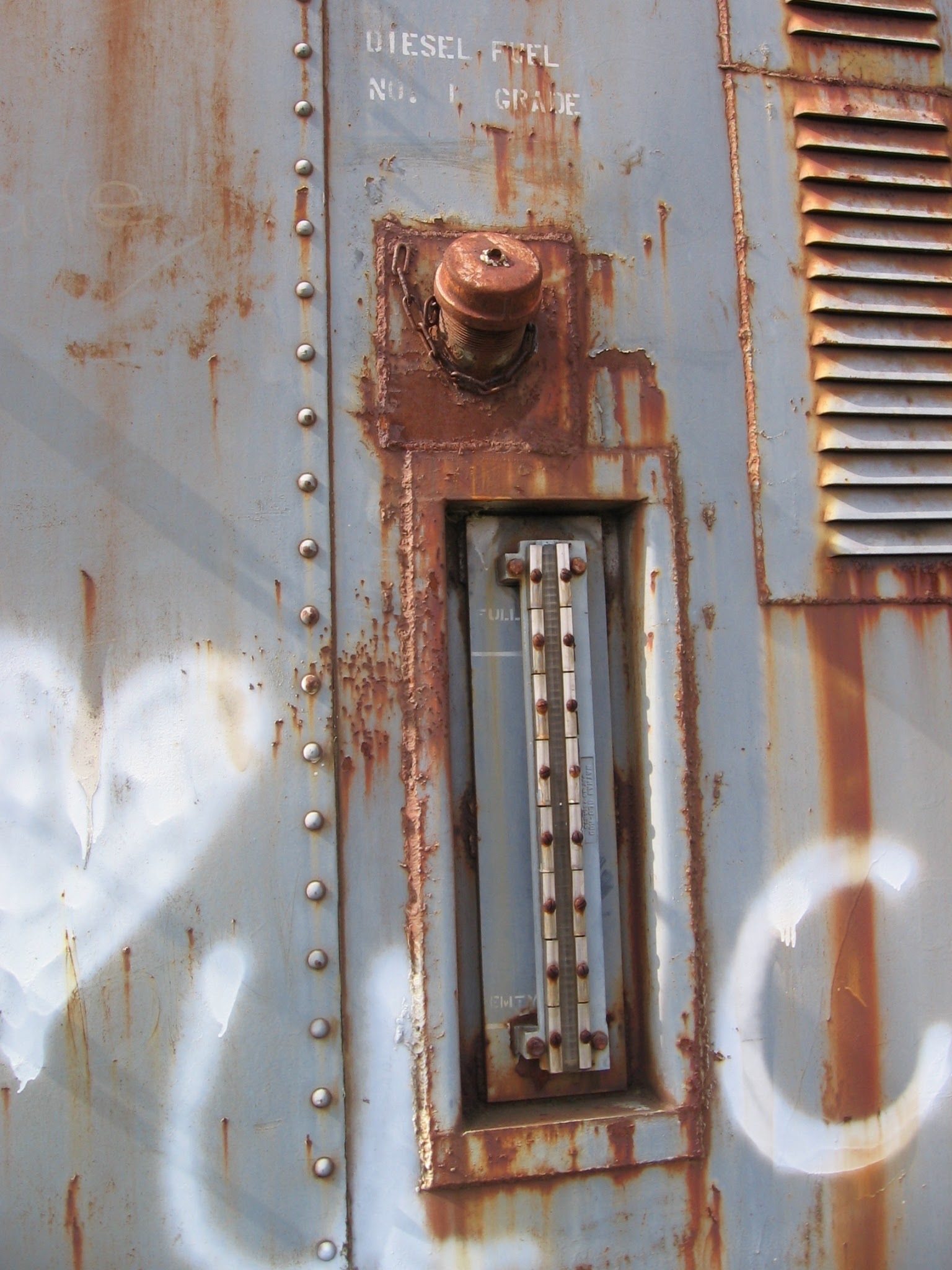
An Air Repeater Car was placed at or near the middle of a long freight train to improve the response of the air brakes during cold weather, using an on-board diesel-powered air compressor to receive pneumatic signals from the brake pipe from the front of the train and relay those signals to produce a corresponding action brake pipe at the rear of the train.

Southern Pacific Air Repeater Car #263 at Lebanon, Oregon, on March 3, 2006

The Air Repeater Car features a diesel fuel filler and fuel level light glass for the diesel-powered air compressor.

Southern Pacific Air Repeater Car #263 at Lebanon, Oregon, on March 3, 2006

The cars could be operated in either direction, with two air connections at each end.

Southern Pacific Air Repeater Car #263 at Lebanon, Oregon, on March 3, 2006

The green pipe connected to the front of the train and the yellow pipe connected to the rear of the train.

Southern Pacific Air Repeater Car #263 at Lebanon, Oregon, on March 3, 2006

Air repeater cars were used at Eugene, OR, Sparks, NV, and Roseville, CA.

Southern Pacific Air Repeater Car #263 at Lebanon, Oregon, on March 3, 2006

Later, they were used as stationary air compressors wherever they were needed.

Southern Pacific Air Repeater Car #263 at Lebanon, Oregon, on March 3, 2006

The last date on the COTS (Clean, Oil, Test & Stencil) Stencil under IDT (In-Date Test) is February 19, 1981, suggesting it was not used much after that date, however it did remain on the property long enough to become Union Pacific Building 7910.

Southern Pacific Air Repeater Car #263 at Lebanon, Oregon, on March 3, 2006

Despite all indications that this car was still Union Pacific property, I believe at this point it was owned by the Albany & Eastern.

Albany & Eastern Little Giant Trakrane Model 32 at Lebanon, Oregon, on March 3, 2006

Little Giant Trakrane Model 32. John Lewis Grundon of Des Moines, Iowa, founded the Des Moines Dragline Company in 1946 and incorporated it as the Little Giant Crane & Shovel Inc. in 1960. The company was sold to Avis Industrial Corporation of Upland, Indiana, in October 1995. The Little Giant factory in Des Moines was closed in January 2001, and production was moved to the Badger Equipment Company of Winona, Minnesota, founded in 1945 and purchased by Avis Industrial in 1978. Badger and Little Giant were sold to Manitex International in 2009.

Albany & Eastern Little Giant Trakrane Model 32 at Lebanon, Oregon, on March 3, 2006

The Trakrane featured this herald for the Albany & Eastern Railroad Company.

Albany & Eastern GP38-3 #2002 at Lebanon, Oregon, on March 3, 2006

Later in the day, I saw this train at the Tangent Street railroad crossing, pulled by Albany & Eastern #2002, sister engine to #2001.

Albany & Eastern GP38-3 #2002 at Lebanon, Oregon, on March 3, 2006

Albany & Eastern #2002 was built by the Electro-Motive Division of General Motors in February 1970 as Illinois Central #9511, one of an order of 20 2,000-horsepower GP38AC locomotives. In 1972, the Illinois Central merged with the Gulf, Mobile & Ohio to become the Illinois Central Gulf, and the locomotive became Illinois Central Gulf #9511. After their original 15-year lease expired, this was one of 18 of the 20 to be leased to the Missouri-Kansas-Texas in 1985, and it became MKT #335. The Missouri-Kansas-Texas was acquired by the Union Pacific, and the locomotive became Union Pacific #1992 on March 6, 1991. After the MKT lease expired, Union Pacific purchased it on October 23, 1996. It was renumbered to Union Pacific #1792 on July 25, 1998. It was assigned Union Pacific #292 in December 1999, but was retired by Union Pacific on May 25, 2001, before being renumbered. In 2002 it came to the Albany & Eastern as GP38-3 #2002.