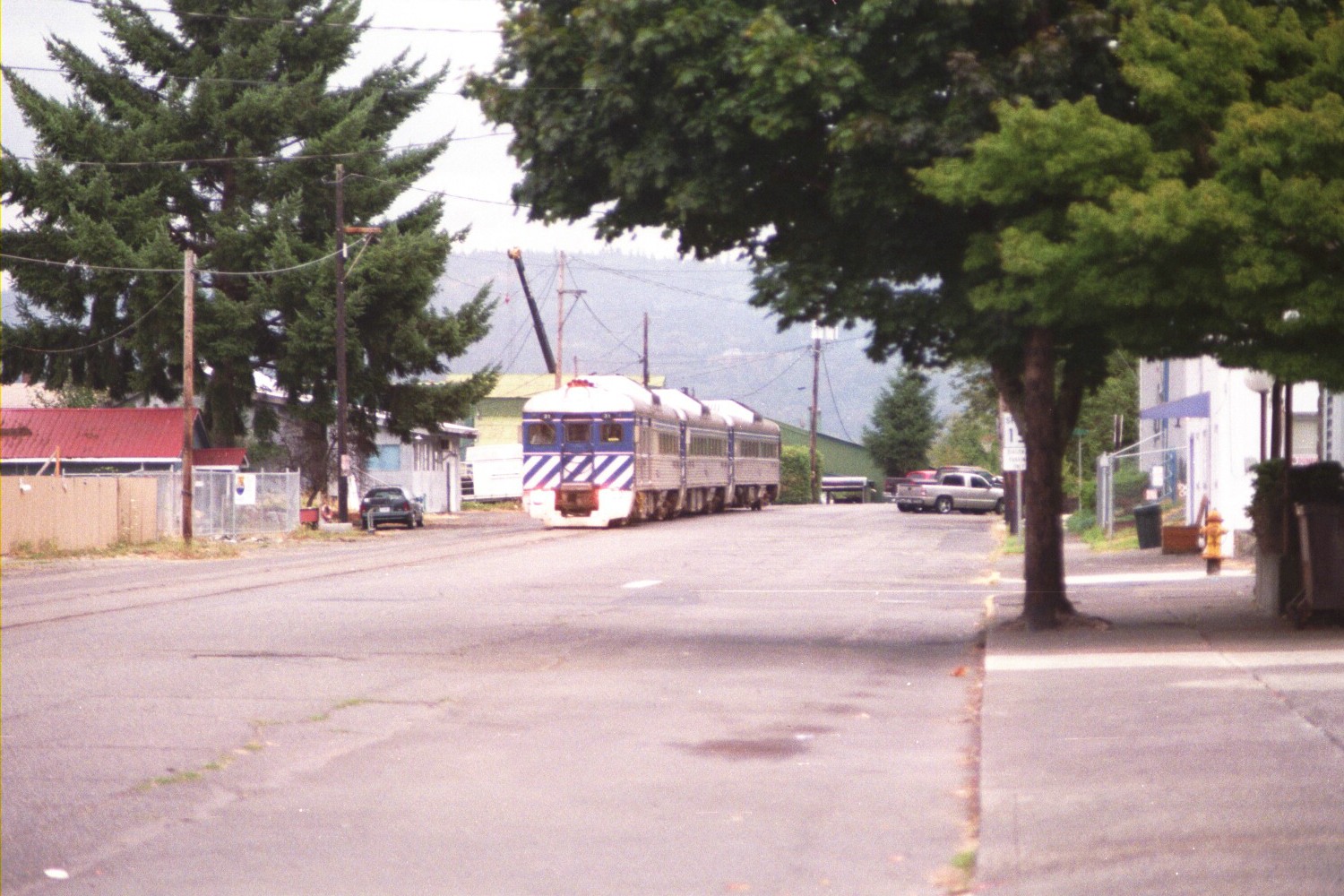
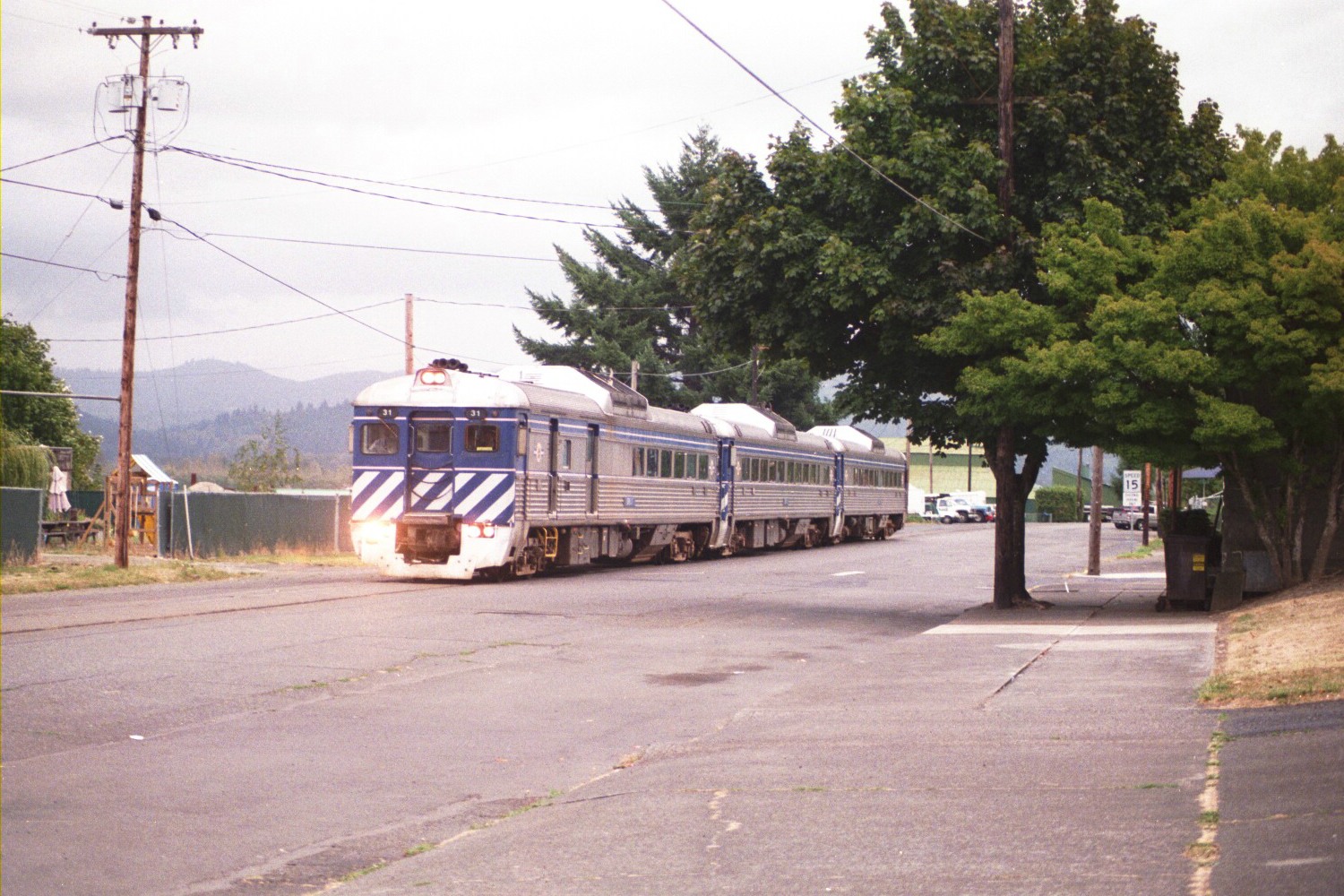
Photo by Cliff West
On Saturday, September 16, 2006, the Pacific Northwest Chapter of the National Railway Historical Society operated the 9-hour “Tillamook Turn” excursion over the Port of Tillamook Bay Railroad from the depot in Banks. Oregon, to Tillamook, Oregon, followed by a 70-minute motor coach return trip to Banks. My dad, Cliff West, took these pictures as one of the 152 passengers on the train that Saturday. The excursion train consist was made up of vintage railcars with large windows and reclining seats in Coach Class or club chairs in the Premium Class lounge and observation cars, along with an open car. The train trip included a complementary lunch, plus on-board snacks and souvenirs for sale.

Starting at the rear of the train with the helper locomotive pushing the train up to the summit, Port of Tillamook Bay #4432 was built by the Electro-Motive Division of General Motors in March 1955 as Southern Pacific #5410, a 1,750-horsepower SD9 that was placed in service on April 19, 1955. After the 1965 system renumbering, it became Southern Pacific #3888. On November 23, 1977, it was rebuilt by Southern Pacific’s Sacramento Shops to SD9R #4432. It was retired on January 11, 1993, and sold on July 22, 1993, to Levin Metals in Richmond, California. It was acquired by the Port of Tillamook Bay Railroad in September 1993.

My dad spent the trip riding in the last car of the train, which was Melbo Land & Equipment Company Open Car MLIX #5601. This car was converted from a gondola car by Bob Melbo when he worked for the Willamette & Pacific Railroad in the 1990s.
The next two cars were Oregon Coast Explorer #552 & #553. These cars are Budd RDC-1 self-propelled railcars that were built in June 1953 as Central Railroad of New Jersey #552 & #553. They were transferred to the New Jersey Department of Transportation in 1976 and to New Jersey Transit in 1983. They were renumbered to #5191 and #5192 before being sold in 1986 and coming to Oregon where they regained their original numbers, being acquired by the Port of Tillamook Bay Railroad in April 1990.
The two Budd RDC-1s took the place of the Pacific Northwest Chapter's coach #6800, which was intended to be used in this train but a short line did not deliver it in time for it to be included. Coach #6800 was built by American Car & Foundry and delivered on May 13, 1950 as Great Northern #1147, a diner-observation for the St. Paul, MN to Grand Forks, ND Red River that seated 20 in the lounge and 21 in the diner. It was converted into a 68-seat coach in 1963, with reversible seats and tile flooring. It became Burlington Northern #6800 in 1970 and Amtrak #6800 in 1974. It was sold to Bill Gawzner in 1978 and then to Great Western Tours of Yreka, CA in 1980, where it was #568. The car accompanied #4449 in the 1984 Louisiana Worlds Fair Daylight. The Pacific Northwest Chapter of the National Railway Historical Society purchased it in April of 1986.

Ahead of the RDC-1s was the Pacific Northwest Chapter's coach #6200. This car was ordered from the Budd Company by the Seaboard Air Line Railroad in October 1938 for the new Silver Meteor between New York and Miami. This car was delivered as 60-seat coach #6200 in January 1939. The Silver Meteor began operation on February 2, 1939 with a 7-car train operating on a 6-day cycle making New York-Miami and New York-St. Petersburg round trips. The Silver Meteor was notable for being a stainless-steel streamliner with full-length, non-articulated cars operating long-distance over several railroads. Three more Silver Meteor train consists plus three additional cars were placed in service on December 23, 1939. The additional equipment allowed for daily Silver Meteor service between New York and Miami, with the three additional cars running through to St. Petersburg. In 1967, this car was rebuilt as Seaboard Coast Line 56-reversible seat coach #5604. It became Amtrak #5604 in 1971. A private party purchased it from Amtrak and it was sold through a car broker to the Seattle & North Coast Railroad. It was purchased by the Pacific Northwest Chapter of the National Railway Historical Society from the bankruptcy estate of the Seattle & North Coast Railroad in 1985. It was lettered for the Willamette & Pacific Railroad for a business excursion. A model of this car is in the Smithsonian Institution in Washington, D.C.
Ahead of Coach #6200 was Willamette & Pacific Baggage Car #262. This car was rebuilt by Great Northern from a heavyweight passenger car into a 74’ baggage car in 1945. After the Great Northern was merged into Burlington Northern on March 2, 1970, it was assigned Burlington Northern #781, though that number may not have been applied before Amtrak took over passenger service in 1971. This car was retained by Burlington Northern and was assigned to maintenance of way service and renumbered to #976081. After being retired by Burlington Northern, it was operated by the Friends of SP 4449. It was painted in Southern Pacific Daylight colors with Willamette & Pacific lettering around 1995 for use in special promotional trains on the Willamette & Pacific which were pulled by 4449 (which was also so lettered, albeit temporarily).
Ahead of Baggage Car #262, the Mount Hood, SP&S #600, was ordered from the Pullman-Standard Manufacturing Company of Chicago in September, 1946 by the Spokane, Portland & Seattle Railway for the Portland section of Great Northern's Empire Builder. It was delivered in February 1950. It and sister car Mount St. Helens are sleeper-lounge cars with a small kitchen and 22-seat lounge with a Farnsworth radio, six single-person roomettes and three large 2-person compartments, two of which could open up to form a 4-person room. The Portland section of the Empire Builder only required one set of equipment, however two of these cars were built so that one could remain in Spokane after the westbound train departed, allowing the Spokane passengers from the eastbound train, which arrived shortly before midnight, to wake up at a more reasonable hour of the morning. The Mount Hood was refurbished by Pullman in 1968 as the company's last project before exiting the sleeping car business. When the SP&S became part of Burlington Northern in 1970, the Mount Hood was assigned #1205. The Mount Hood logged almost 5.3 million miles between Spokane and Portland on SP&S and Burlington Northern passenger trains. It was leased by Amtrak from May 1, 1971 until early 1972 and operated between Chicago and Seattle. In 1972, Burlington Northern donated the car to thePacific Northwest Chapter of the National Railway Historical Society. In 1981, the Mount Hood was painted in Southern Pacific Daylight colors to accompany #4449 to the opening of theCalifornia State Railroad Museum and on the 7,477-mile 51-day excursion to the Louisiana World’s Fair in New Orleans in 1984. It was repainted into its original colors, which it still wears today, for the 1985AARPCO/Union Station neon sign relighting celebration. Mount Hood's sister car Mount St. Helens was originally sold to Arvin Benson of Moorehead, Minnesota. It still exists and is now at the Inland Northwest Rail Museum at Reardon, Washington, near Spokane.
The first car in the train, Southern Pacific streamlined Parlor/Lounge Observation Car #2955 was built by the Pullman-Standard Company in July 1941 for use on the Morning Daylight between Los Angeles & San Francisco, the same service #4449 was used in, and #4449 almost certainly pulled #2955 at some point in regular service. In July 1949, #2955 was transferred to the Shasta Daylight between Oakland and Portland. It was converted to a 72-seat coach in 1960. Most of #2955's sister cars were rebuilt into full-dome cars by Southern Pacific's Sacramento Shops; #2955 is one of only two to remain as round-end cars. After Southern Pacific retired it, the car was acquired by the Stockton Terminal & Eastern Railroad and ended up being heavily vandalized. The car was acquired by the Northwest Rail Museum of Portland in 1988 and restored to its original Daylight colors. It is named James J. Gilmore after a volunteer who worked on the car but passed away before having the opportunity to enjoy it in excursion service. It is the only former Southern Pacific round-end observation car remaining in service. This car would bring up the rear of the train when it made the return trip from Tillamook to Banks on Sunday, September 17.

The Pacific Northwest Chapter of the National Railway Historical Society is an all-volunteer 501(c)(3) charitable and educational non-profit Oregon corporation that was formed in 1955 to preserve the history of railroading in the Northwest, educate the public about that history, and encourage rail travel, and it has been operating excursions practically since its inception. It has more than 250 members ranging in age from 16 to over 90 years old including many dedicated rail professionals, and maintains a library and archives along with over a dozen pieces of rolling stock.

The railroad to Tillamook was originally built by the Pacific Railway & Navigation Company, which was incorporated on October 13, 1905. Grading began on November 20, 1905, and the first rails were laid on December 6, 1905. By June 30, 1906, 10 miles of track had been laid, and by the following year another 7 miles were laid. On September 2, 1907, the railroad ran its first train. The Southern Pacific Company, which first acquired an interest in the PR&N in 1906, assumed control on June 5, 1909. By November 20, 1909, the railroad had graded 70 miles, with 35 miles of track laid west from Hillsboro and 12 miles of track laid east from Tillamook.

Traversing the narrow, rocky canyons of the Salmonberry and Nehalem Rivers through the lush rainforests to cross the Coast Range mountains to the Pacific Ocean required a maximum grade of 3.37% with sharp horseshoe curves, high trestles over rivers and streams, and 13 tunnels (10 of which remain), making this one of Oregon’s most scenic railroads. The heavy winter rainfall led the railroad workers to quickly nickname the PR&N as the “Punk, Rotten & Nasty.”

Construction of the 91-mile railroad was completed on June 30, 1911, and on October 9, 1911, the first train ran from Portland to Tillamook, using trackage right over the Southern Pacific for 21 miles from Portland to Hillsboro. On July 1, 1915, the Pacific Railway & Navigation Company was taken over by the Southern Pacific and became the Tillamook Branch, Southern Pacific’s most northerly route. On February 1, 1990, the 88-mile line from Banks to Tillamook was sold to the Port of Tillamook Bay and became the Port of Tillamook Bay Railroad.

After being fairly flat out of Banks, the railroad started to climb into the Coast Range after Buxton at a grade of nearly two percent. The first major trestle on the line was 508 feet long and crossed the West Fork of Dairy Creek and Oregon Highway 47 at the first of six horseshoe curves encountered during the climb to Scofield and Strassel.

West of Strassel, the railroad continued to climb for about a mile and a half, passing through the Walcott Tunnel #25 and reaching a false summit before beginning a three-mile descent towards Timber.

Leading the train were Port of Tillamook Bay Railroad locomotives #4405 & 4406.
Port of Tillamook Bay #4405 was built by the Electro-Motive Division of General Motors in April 1955 as Southern Pacific #5421, a 1,750-horsepower SD9 that was placed in service on April 19, 1955. After the 1965 system renumbering, it became Southern Pacific #3899. On September 30, 1975, it was rebuilt by Southern Pacific’s Sacramento Shops to SD9E #4405. It was retired on January 4, 1991, and sold on July 22, 1993, to Levin Metals in Richmond, California. It was acquired by the Port of Tillamook Bay Railroad in September 1993.
Port of Tillamook Bay #4406 was built by the Electro-Motive Division of General Motors in April 1955 as Southern Pacific #5418, a 1,750-horsepower SD9 that was placed in service on April 14, 1955. After the 1965 system renumbering, it became Southern Pacific #3896. On October 31, 1975, it was rebuilt by Southern Pacific’s Sacramento Shops to SD9E #4406. It was retired on November 26, 1991, and sold on July 22, 1993, to Levin Metals in Richmond, California. It was acquired by the Port of Tillamook Bay Railroad in 1994.

The train entered the wood-framed east portal of the 1,417-foot Walcott Tunnel #25.

The Walcott Tunnel #25 was the first tunnel on the line and the only one not in the Salmonberry River canyon.

Hanging above the east portal of the Walcott Tunnel was a wooden sign designating it the Senator Gordon Smith Tunnel 25 and indicating the elevation of 1,250 feet above sea level.

After passing Timber, the line began its final and steepest climb up along the Nehalem River to the summit at Cochran at milepost 800.0, reaching an elevation of 1,833 feet.

Between Cochran and Enright, the train crossed the Wolf Creek Trestle. Wolf Creek is a tributary in a side canyon off the Salmonberry River, which the railroad followed down the other side of the Coast Range.

The railroad turned up the Wolf Creek canyon and began crossing this high curved trestle after emerging from Tunnel #27, making a horseshoe curve across the creek to return down the other side of the canyon on a 2.7% grade to continue down the Salmonberry River for about 15 miles.

From Wolf Creek, the railroad followed the Salmonberry River, passing through multiple tunnels before passing through Enright at milepost 811.0.

Enright once featured a logging reload connection with a logging railroad, a train order station, a steel water tower, and a 65-foot turntable for helper locomotives to return to east after assisting trains over the summit.

The railroad continued down the Salmonberry River from Enright until emerging from the canyon at Salmonberry at milepost 815.7.

By the time the railroad reached Mohler, the Salmonberry River had joined the Nehalem River and the railroad had leveled out as it followed the Nehalem downstream towards the Pacific Ocean. It crossed Miami Foley Road at the intersection with Foss Road which paralleled the Nehalem River along with the railroad.

This is a view from the train of the Nehalem River near Wheeler, Oregon, just before it opens up into Nehalem Bay. From Wheeler, the railroad followed US Highway 101 as the Nehalem River nears its end at Nehalem Bay and the Pacific Ocean.

South of Brighton, the railroad ran between Highway 101 and the Nehalem River just before it empties into the Pacific Ocean.

Entering Garibaldi, the railroad ran along Tillamook Bay, passing these houses on Bay Lane.

The railroad continued to follow Highway 101 through downtown Garibaldi.

Before reaching Bay City, the railroad strayed from the Highway and the ocean briefly as it went around Larson Cove.

Shortly after passing through Idaville, the train crossed the Kilchis River. This bridge was built in 1898 and had a total length of 280 feet with a 140-foot Pratt through truss main span. The north approach also crossed Possetti Road.

Nearing Tillamook, the train approached a bridge across Old Latimer Road and the Wilson River.

Shortly after entering Tillamook, the railroad crossed Third Street and passed the Hampton Lumber Company mill, which was also across the tracks from the former Southern Pacific Tillamook depot which closed in 1977. Here, the "Tillamook Turn" passed an excursion train of the Oregon Coast Scenic Railroad, which was established in 2002 to operate over the Port of Tillamook Bay Railroad.

Curtiss Lumber Company #2 is a 2-Truck Heisler that was built by the Heisler Locomotive Works of Erie, Pennsylvania, in March of 1910 for the Curtiss Lumber Company of Mill City, Oregon. This geared logging locomotive worked out of Mill City for its entire career as #2 as its ownership changed over the years, starting in January 1912 with the Hammond Lumber Company, then the Mill City Manufacturing Company, then the Vancouver Plywood & Veneer Company, and finally the Wills Shingle Company. After being retired and stored for years, it was acquired by Jack Rodgers in 1972 for his Golden Age of Logging Museum in Ashford, Washington, and it was restored to operation as Tenas Creek & Eastern #2 in 1974. Following the closure of the museum in the 1990s, the entire Rodgers collection was purchased by Jack Anderson in 1997 and moved to the Mt. Rainier Scenic Railroad at Mineral, Washington. In 1999 this locomotive was sold to Scott Wickert in 1999 and was restored to operation at the Mt. Rainier Scenic Railroad shops in Mineral in 2001. In 2003 it was leased to the new Oregon Coast Scenic Railroad for excursion service on the Port of Tillamook Bay Railroad.
At the end of the ride in Tillamook, my dad rode the motor coach back to Banks, concluding this trip. In December 2007, winter storms would cause landslides in the Salmonberry River canyon that would wash out the tracks in several places and lead to that portion of the railroad being abandoned, making this a trip that will likely never be repeated.