Showing posts with label Rainier. Show all posts

Sunday, April 5, 2026

Portland & Western GP39-2 #2309 at Rainier, Oregon

Portland & Western GP39-2 #2309 Philomath at Rainier, Oregon, in April or May 2007
Photo by Cliff West

Portland & Western #2309 “Philomath,” is a 2,300-horsepower GP39-2 that was built by the Electro-Motive Division of General Motors in August 1974 as Atchison, Topeka & Santa Fe #3608. 

Portland & Western GP39-2 #2309 Philomath at Rainier, Oregon, in April or May 2007
Photo by Cliff West

It was retired in December 1992 and was sold to the Willamette & Pacific Railroad in June 1993 and later transferred to the Portland & Western. My dad, Cliff West, photographed it in Rainier, Oregon, in April or May of 2007.

Monday, June 17, 2024

Portland & Western SD40-2MR #3300

Portland & Western SD40-2MR #3300 at Rainier, Oregon, in April 2006
Photo by Cliff West

Portland & Western #3300 is a 3,300-horsepower SD40-3MR that was built by the Electro-Motive Division of General Motors in April 1968 as Colorado & Southern #880, a 3,000-horsepower SD40. Colorado & Southern was a subsidiary of the Chicago, Burlington & Quincy and its successor Burlington Northern, and its locomotives were painted in its parent’s colors, but they had their own numbering system. These locomotives began to be renumbered in the Burlington Northern’s main numbering system in September 1979, and this locomotive became Colorado & Southern #6340. 

Portland & Western SD40-2MR #3300 at Rainier, Oregon, in April 2006
Photo by Cliff West

The Colorado & Southern was formally merged into the Burlington Northern on December 31, 1981, and this locomotive became Burlington Northern #6340. It was retired in February 1987 and sold back to the Electro-Motive Division of General Motors in April 1987. EMD added the locomotive to their lease fleet and it became EMDX #6340. 

Portland & Western SD40-2MR #3300 at Rainier, Oregon, in April 2006
Photo by Cliff West

In 1992 it was rebuilt by EMD as a 3,300-horsepower SD40-3MPR with EM2000 microprocessor controls, HTC trucks and extended range dynamic brakes and became EMDX demonstrator #2000, eventually ending up back in lease service. It was sold to the Portland & Western in August 2004.

Wednesday, January 17, 2024

Trains in Late 2005

Willamette & Pacific GP39-2 #2307 "Independence" at Rainier, Oregon, in late 2005
Photo by Cliff West

My dad, Cliff West, took these train pictures in late 2005. First are three photos of a Willamette & Pacific locomotive in Rainier, Oregon.

Willamette & Pacific GP39-2 #2307 "Independence" at Rainier, Oregon, in late 2005
Photo by Cliff West

Willamette & Pacific #2307 “Independence” is a 2,300-horsepower GP39-2 that was built by the Electro-Motive Division of General Motors in August 1974 as Atchison, Topeka & Santa Fe #3606. It was retired in December 1992 and was sold to the Willamette & Pacific Railroad in June 1993.

Willamette & Pacific GP39-2 #2307 "Independence" at Rainier, Oregon, in late 2005
Photo by Cliff West

This bridge over Fox Creek in Rainier, Oregon, is located at railroad milepost 46.0. This wooden bridge probably dates from the railroad's original construction in 1897-98. The first train came through Rainier from Astoria to Portland on the morning of May 16, 1898. The railroad was originally called the Astoria & Columbia River Railroad. On February 24, 1911 the Spokane, Portland & Seattle took over. The SP&S became part of the Burlington Northern on March 2, 1970. The line to Astoria was purchased by the Portland & Western Railroad in 1996. 

BNSF Dash 8-40BW #518 & GP50 #3126 at Vancouver, Washington, in late 2005
Photo by Cliff West

This picture of BNSF equipment was taken at the Amtrak depot in Vancouver, Washington. In the foreground, BNSF #518 is a 4,000-horsepower Dash 8-40BW that was built by General Electric in October 1990 as Atchison, Topeka & Santa Fe #518.  Following the merger of the Burlington Northern and the Atchison, Topeka & Santa Fe on September 22, 1995, it became BNSF #518 in April 2001 and was repainted into BNSF’s “Heritage II” paint scheme in May 2001. In the background, BNSF #3126 is a 3,500-horsepower GP50 built by the Electro-Motive Division of General Motors in August 1985 as Burlington Northern #3126. Following the merger of the Burlington Northern and the Atchison, Topeka & Santa Fe on September 22, 1995, it became BNSF #3126 on June 3, 2002. 

Montana Rail Link Covered Hopper #45028 at Linnton, Oregon, in late 2005
Photo by Cliff West

Montana Rail Link #45028 is a Pullman-Standard PS2-CD 4427-cubic-inch 100-ton covered hopper that was originally built in March 1971 as part of lot 9532, a group of 200 such cars built for the St. Louis-San Francisco Railway, or Frisco, numbered from 79300 to 79499. The Frisco was merged into the Burlington Northern Railroad in April 1980, and these cars became Burlington Northern 439000-439199. A group of 50 of these cars went to the Montana Rail Link after its creation in October 1987, and were numbered 45001-45050. Initially painted dark blue, they were used to carry materials such as lime, talc, and decorative rock, which caused the dark blue paint to weather quickly. When my dad photographed this car in Linnton, Oregon, it had recently been renovated and repainted light gray, which was expected to hold up better than the dark blue. 

Tuesday, December 26, 2023

Lewis & Clark Explorer in 2005

Lewis & Clark Explorer at Rainier, Oregon, in 2005
Photo by Cliff West

To commemorate the bicentennial of the Lewis and Clark Expedition, the Oregon Department of Transportation operated an excursion train along the south bank of the lower Columbia River from Linnton, near Portland, to Astoria, near the site of Fort Clatsop, where the Lewis and Clark Expedition wintered over in 1805-06. The train ran for the summers of 2003 to 2005, making one round trip on Fridays, Saturdays, Sundays and Mondays. My dad, Cliff West, took these pictures of the train during its final season in 2005, around July. These first pictures show the westbound train approaching Rainier.

Lewis & Clark Explorer at Rainier, Oregon, in 2005
Photo by Cliff West

Charles Fox founded Rainier in 1851. The town was originally called Eminence, but the name was changed to Rainier in 1852. The town is named after Rear Admiral Peter Rainier of the Royal Navy, for whom Mt. Rainier in Washington is also named. The town of Rainier was incorporated in 1885. According to the 2000 census, Rainier has a population of 1,687 people.
Lewis & Clark Explorer approaching Rainier, Oregon, in 2005
Photo by Cliff West

On another day, the westbound train is shown approaching Rainier from another vantage point.
Lewis & Clark Explorer approaching Rainier, Oregon, in 2005
Photo by Cliff West

Rainier is my hometown, so it is covered more extensively than the other towns. 

Lewis & Clark Explorer at Rainier, Oregon, in 2005
Photo by Cliff West

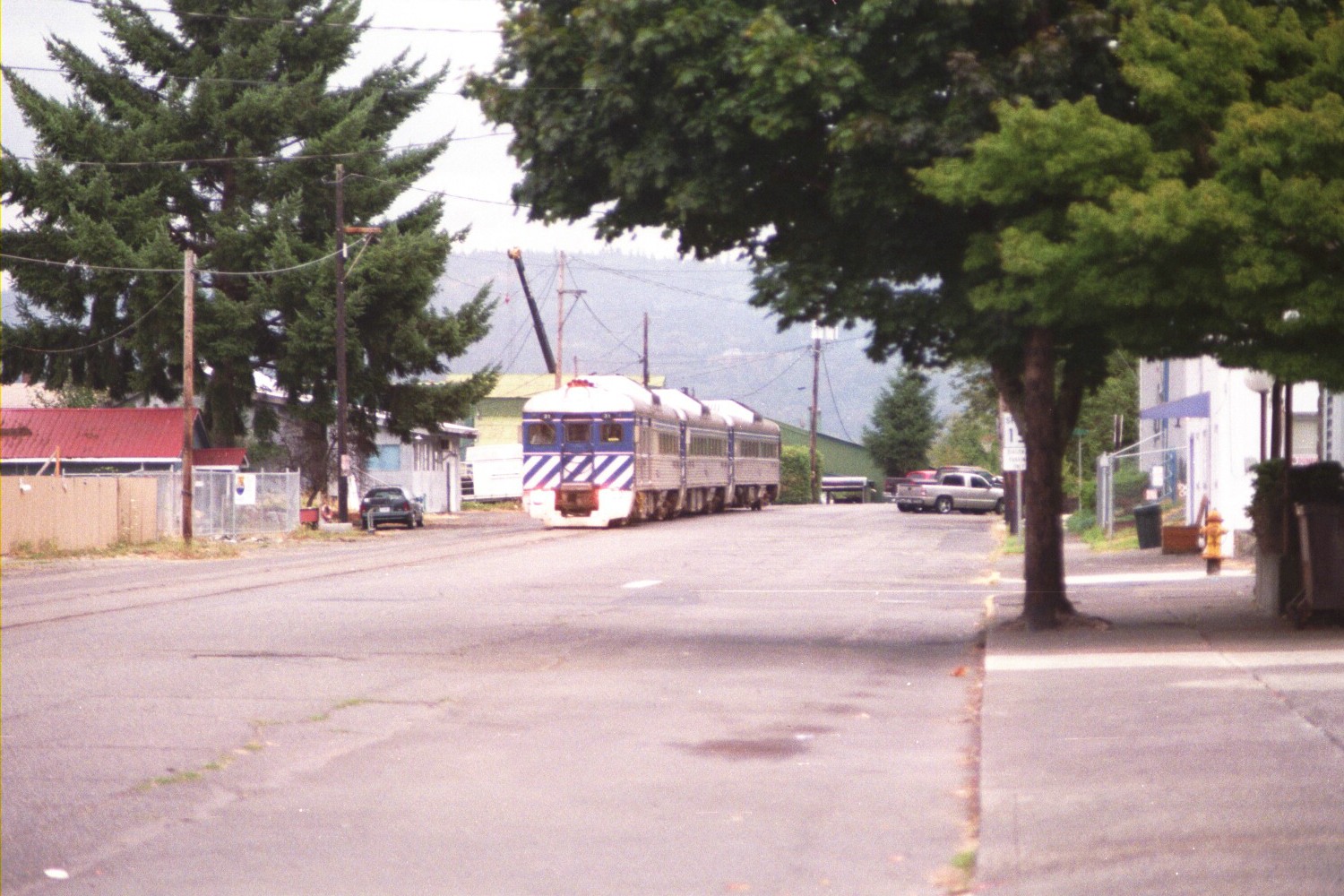
The railroad runs down the middle of A Street in downtown Rainier. Street-running used to be common for railroads in the United States, but today it is becoming rare.
Lewis & Clark Explorer at Rainier, Oregon, in 2005
Photo by Cliff West

Later in the season, around September 2005, the westbound Lewis & Clark Explorer passes Riverfront Park in Rainier.

Lewis & Clark Explorer at Rainier, Oregon, in 2005
Photo by Cliff West

On another day around September 2005, the westbound Lewis & Clark Explorer runs down East A Street.

Lewis & Clark Explorer at Rainier, Oregon, in 2005
Photo by Cliff West

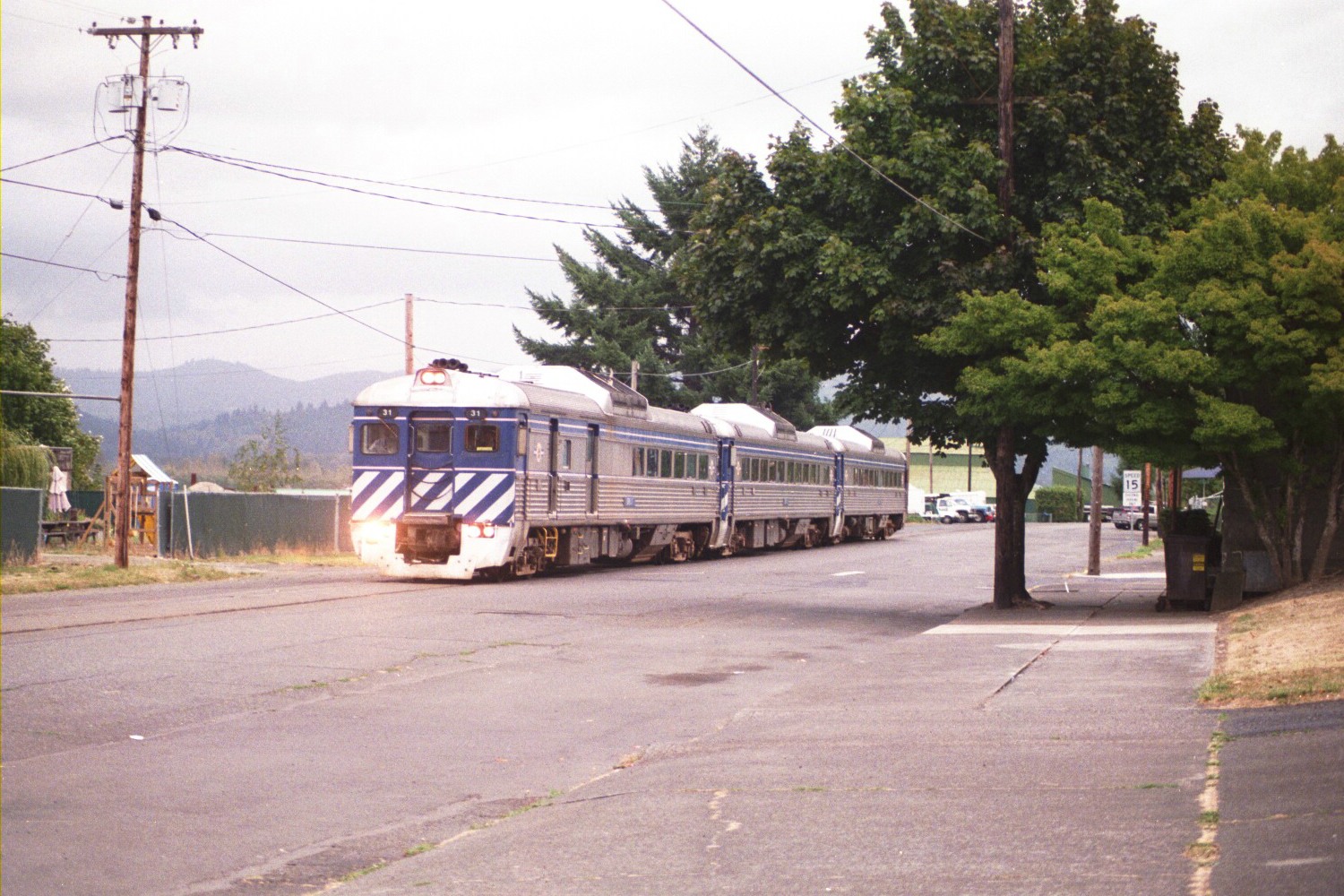
The train consisted of three self-propelled passenger cars known as Rail Diesel Cars, or RDCs, introduced by the Budd Company in 1949 and built throughout the 1950s. Budd was a major builder of railcars at the time, specializing in stainless steel streamlined passenger cars. These cars were purchased by the state of Oregon's Department of Transportation from the British Columbia Railway, which had ended its passenger service in 2002.

Lewis & Clark Explorer at Rainier, Oregon, in 2005
Photo by Cliff West

RDC's are powered by 2 Detroit Diesel Series 110 V-6 engines, each producing about 275 horsepower, giving each RDC about 550 horsepower. This is enough power for an RDC to move itself rather quickly, however an RDC does not have much power for pulling additional cars. As a result, each RDC in a consist must be operational. RDCs have a control cab at each end, and a single RDC can control all the other RDCs coupled to it. The hump in the roof at the center of an RDC contains the exhaust and cooling for the engines, freeing up space inside the cars for passengers.

Lewis & Clark Explorer at Rainier, Oregon, in 2005
Photo by Cliff West

Leading the train, ORRX #31 is an RDC-3 originally built by Budd in July 1956 for the Great Northern Railway as #2350. The RDC-3 featured a section at one end of the car for baggage and mail. #2350 became Burlington Northern #2350 in 1970 and later became Amtrak #43. The British Columbia Railway purchased the car in January 1976 to replace their original #BC-31, which was destroyed in a fire on November 26, 1973. Trailing behind, ORRX #10 & #11 are RDC-1s built in August 1956 by Budd for British Columbia Railway's predecessor Pacific Great Eastern as #BC-10 and #BC-11. The RDC-1 was the passenger-only model of Budd's RDC line. The Pacific Great Eastern became the British Columbia Railway on April 1, 1972, when it was taken over by British Columbia's provincial government. The railroad began going by the name BC Rail on June 19, 1984. These RDC's are still in BC Rail paint, with only the BC Rail heralds replaced by the Lewis & Clark Explorer heralds.

Lewis & Clark Explorer at Rainier, Oregon, in 2005
Photo by Cliff West

On another sunnier day around September 2005, the westbound Lewis & Clark Explorer runs down East A Street.


Lewis & Clark Explorer at Rainier, Oregon, in 2005
Photo by Cliff West

How the three RDCs were coupled together varied. Sometimes the RDC-3 #31 was at one end, other times it was in the middle. The three were rarely separated, so they remained as they were coupled for quite a while.
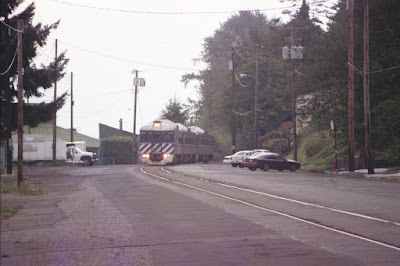
Lewis & Clark Explorer at Rainier, Oregon, in 2005
Photo by Cliff West

Near the end of the final season, in late September 2005, the westbound Lewis & Clark Explorer enters Rainier.
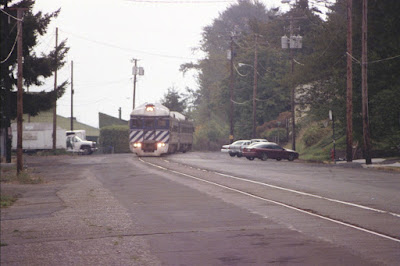
Lewis & Clark Explorer at Rainier, Oregon, in 2005
Photo by Cliff West

The Lewis & Clark Explorer was the first scheduled passenger service on this rail line since 1952.

Clatskanie River Drawbridge at Clatskanie, Oregon, in 2005
Photo by Cliff West

Clatskanie takes its name from the Tlatskanai Indians, a very warlike tribe that inhabited this area. The Tlatskanai were wiped out by a smallpox epidemic in the 1850s. Clatskanie was first settled in 1852. It was originally called Bryantville. Clatskanie was incorporated in 1891. According to the 2000 census, Clatskanie has a population of 1,528 people. Unlike the other towns, which the railroad runs right through the middle of, the railroad only skirts along the edge of Clatskanie. At the west end of town, the railroad crosses the Clatskanie River on a swing-type drawbridge built in 1897. 

Clatskanie River Drawbridge at Clatskanie, Oregon, in 2005
Photo by Cliff West

This bridge must be manually swung by a handcrank in the center of the span. This is the first of three manual drawbridges the train crosses. The bridge is normally kept open for river traffic, and is only swung closed when a train is waiting. 
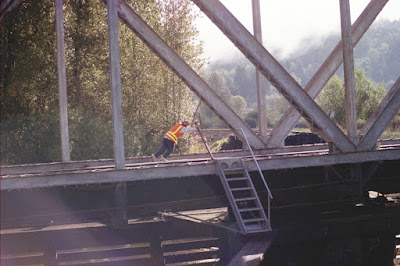
Clatskanie River Drawbridge at Clatskanie, Oregon, in 2005
Photo by Cliff West

For freight trains, a railroad employee swings the bridge. For the Lewis & Clark Explorer, the bridge was swung by specially trained volunteers. 

Clatskanie River Drawbridge at Clatskanie, Oregon, in 2005
Photo by Cliff West

In these pictures, taken from the west side of the bridge, you can see the walkway to get to the span when the bridge is open, and the volunteer walking around the circular walkway in the middle, using the removable pole to turn the handcrank.

Clatskanie River Drawbridge at Clatskanie, Oregon, in 2005
Photo by Cliff West

This is the bridge at which the Portland & Western freight train crew switching the Stimson Lumber mill at Clatskanie pushed a carload of lumber off the approach to the open drawbridge into the river on September 2, 2004. The train was operating on the east side of the bridge, so in the pictures it is the far approach that was damaged. Since the bridge was completely open at the time, the main span was not damaged.
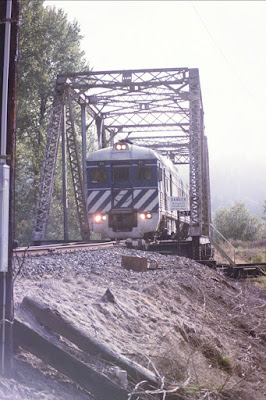
Lewis & Clark Explorer on the Clatskanie River Drawbridge at Clatskanie, Oregon, in 2005
Photo by Cliff West

This damage to the bridge approach closed the line for the entire Labor Day weekend, forcing that weekend's trips of the Lewis & Clark Explorer to be cancelled. The bridge approach was repaired and the line reopened in time for the rest of the season to be completed.

Lewis & Clark Explorer near Westport, Oregon, in 2005
Photo by Cliff West

Between Clatskanie and Westport the Astoria line closely parallels U.S. Highway 30. This picture shows the eastbound Lewis & Clark Explorer in this area.

Lewis & Clark Explorer at Westport, Oregon, in 2005
Photo by Cliff West

John West settled in Westport in 1850. The post office opened in 1863. Westport is located on Westport Slough, a side channel of the Columbia River. This location shelters the shore at Westport from the current in the river's main channel, making the slough a relatively good place for boaters and fishermen. Since 1925, a car ferry has connected Westport with Puget Island. This small ferry operation proves itself essential when construction or another emergency temporarily closes one of the bridges at Rainier or Astoria. This picture shows the westbound Lewis & Clark Explorer as it moves through Westport.

Lewis & Clark Explorer at Knappa, Oregon, in 2005
Photo by Cliff West

The town of Knappa was named after Aaron Knapp, Jr., an early settler of the area. The Knappa post office operated from 1873 to 1943. The actual town of Knappa is actually a little inland from the river, and the railroad stays close to the river here and doesn't actually go through Knappa. Two roads cross the railroad at Knappa. Knappa Road crosses above the tracks on an old wooden overpass. Waterhouse Road crosses the tracks at a traditional grade crossing. But this grade crossing is unique; it is still protected by an antique railroad crossing signal known as a Magnetic Flagman or wigwag.

Lewis & Clark Explorer at Knappa, Oregon, in 2005
Photo by Cliff West

Just north of the tracks, Waterhouse Road turns to intersect with Knappa Road, which is just to the east. The Knappa Road overpass is adjacent to the Waterhouse Road crossing, making this a very photogenic spot for train photographs. Unfortunately, the Portland & Western has no freight business this far down the line, so without the Lewis & Clark Explorer train, this area sees almost no rail traffic.

Wigwag Railroad Crossing Signal at Knappa, Oregon in 2005
Photo by Cliff West

This type of signal was manufactured by the Magnetic Signal Company of Los Angeles, California from 1910 to 1949. It takes its name from the movement it makes; the black and white banner with the red light in the middle swings, "wigwags" back and forth. The movement is similar to that made by a human flagman while swinging a flag or lantern to stop traffic. The signal also features a bell. This wigwag was removed in March of 2007.
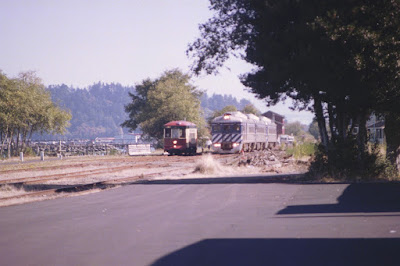
Astoria Riverfront Trolley & Lewis & Clark Explorer at Astoria, Oregon, in 2005
Photo by Cliff West

Astoria is the oldest settlement west of the Rocky Mountains. Fur traders sent by John Jacob Astor built Fort Astoria in 1811. Astoria is the county seat of Clatsop County. According to the 2000 census, Astoria has a population of 9,813 people.

Astoria Riverfront Trolley & Lewis & Clark Explorer at Astoria, Oregon, in 2005
Photo by Cliff West

The tracks along the waterfront through Astoria are used by the Astoria Riverfront Trolley.

Lewis & Clark Explorer at Astoria, Oregon, in 2005
Photo by Cliff West

The Lewis & Clark Explorer's journey ends, appropriately enough, in front of the old Astoria railroad depot. The depot was built in 1924, the peak year for rail travel in Astoria. The railroad continued to use the building for decades after passenger service ended, but today the building is owned by the Columbia River Maritime Museum. It is closed to the public as it is in need of serious repair and is only used for storage.

Lewis & Clark Explorer at Rainier, Oregon, in 2005
Photo by Cliff West

Back in Rainier on another, wetter day, the Lewis & Clark Explorer makes one of its last trips down the middle of A Street.

Lewis & Clark Explorer at Rainier, Oregon, in 2005
Photo by Cliff West

The ditch lights on the front of the RDC shined brightly on this gloomy day.
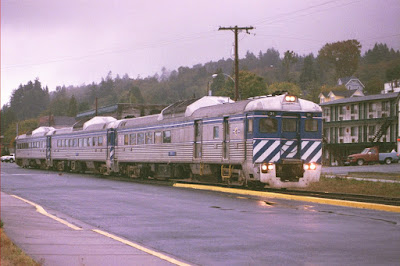
Lewis & Clark Explorer at Rainier, Oregon, in 2005
Photo by Cliff West

The street running in Rainier ended at West 2nd Street, and the rail line ran alongside a narrower A Street from there.

Lewis & Clark Explorer at Rainier, Oregon, in 2005
Photo by Cliff West

On another day near the end of the final season, the Lewis & Clark Explorer runs down A Street in Rainier. 

Lewis & Clark Explorer at Rainier, Oregon, in 2005
Photo by Cliff West

At West 2nd Street, the train leaves the street and has its own separate right of way again.

Lewis & Clark Explorer at Rainier, Oregon, in 2005
Photo by Cliff West

After leaving the street-running behind, the railroad crosses over Fox Creek on an old wooden trestle that probably dates from the railroad's original construction in the 1890s.

Lewis & Clark Explorer at Rainier, Oregon, in 2005
Photo by Cliff West

I believe this was the last run of the Lewis & Clark Explorer on October 3, 2005.

Sunday, November 26, 2023

St. Lawrence & Atlantic (LLPX) GP40 #3208 in Rainier, Oregon, in the summer of 2005

St. Lawrence & Atlantic (LLPX) GP40 #3208 in Rainier, Oregon, in the summer of 2005

St. Lawrence & Atlantic #3208 is a 3,000-horsepower GP40 that was built by the Electro-Motive Division of General Motors in January 1967 as Chicago, Rock Island & Pacific #375. This was one of a group of seven GP40s that the Rock Island was rebuilding to Dash 2 standards in its Silvis shops when the railroad went bankrupt and shut down in 1980. Before the shutdown it was completed as GP40u #3002. The last two of the seven were unfinished. Chrome Crankshaft acquired all seven locomotives along with the shop in 1981, and finished the remaining two locomotives.

St. Lawrence & Atlantic (LLPX) GP40 #3208 in Rainier, Oregon, in the summer of 2005

The seven locomotives were sold to Toronto’s GO Transit in 1982. This locomotive became GO Transit #721. As they were not equipped with head-end power generators, they had to operate with HEP cars rebuilt from F-units. In 1994 they were retired and traded in to EMD for new F59PHs. EMD put the locomotives in their lease fleet and this locomotive became EMDX #205. 

St. Lawrence & Atlantic (LLPX) GP40 #3208 in Rainier, Oregon, in the summer of 2005

In 2001, EMD transferred the locomotive to Locomotive Leasing Partners (LLPX), a partnership with GATX Leasing, and the locomotive was leased to the St. Lawrence & Atlantic as #3208. Despite its St. Lawrence & Atlantic paint scheme, there was a tiny "LLPX" on each side of the cab under the road number. St. Lawrence & Atlantic was taken over by shortline operator Genesee & Wyoming in 2002.

St. Lawrence & Atlantic (LLPX) GP40 #3208 in Rainier, Oregon, in the summer of 2005

Genessee & Wyoming transferred the locomotive to the Portland & Western Railroad in April 2004, where it was considered a GP40-2, even though it lacks all the Dash 2 external spotting features like the water level sight glass, rear cab overhang, and vertical shock absorbers on the trucks.

St. Lawrence & Atlantic (LLPX) GP40 #3208 in Rainier, Oregon, in the summer of 2005

This locomotive appeared on the Portland & Western’s Astoria Line in the summer of 2005, where I photographed it parked on the trestle over Fox Creek in Rainier, Oregon. I took several pictures, expecting that it would either leave soon to never be seen again, or be repainted. Soon after these photos were taken, it became Portland & Western #3006, with large P&W heralds applied over the St. Lawrence & Atlantic black and yellow paint, and would remain that way for nearly a decade before finally being repainted in Genesee & Wyoming’s standard orange & black paint scheme in 2013 or 2014. 

St. Lawrence & Atlantic (LLPX) GP40 #3208 in Rainier, Oregon, in the summer of 2005
 

Incidentally, the St. Lawrence & Atlantic yellow and black paint scheme is not dissimilar to the Pullman green and yellow paint scheme used by the Spokane, Portland & Seattle Railway, which operated the Astoria Line prior to the Burlington Northern merger of 1970, and had ordered similar-looking GP38s just before the merger that ended up being delivered in BN Cascade Green. If you don’t look too close, this locomotive is almost a glimpse of what might have been.