Wednesday, June 20, 2018

Trains in Oakridge, Oregon, on July 18, 1997

I took these pictures in Oakridge, Oregon, on July 18, 1997. Though it had been almost a year since the Southern Pacific had been merged into the Union Pacific, you wouldn't know it from the equipment stored in Oakridge, which consisted mainly of stored snowfighting equipment and helper sets.

Southern Pacific C-50-9 Caboose #4702 in Oakridge, Oregon, on July 18, 1997

Southern Pacific #4702 is a C-50-9 Bay-Window Caboose that was built by PACCAR Inc. in 1980.

Southern Pacific Flanger SPMW #329 in Oakridge, Oregon, on July 18, 1997

Southern Pacific MW #329 is a flanger, which is used to clear snow from between the rails. I believe it was originally built in the 1950s with a wood body. It was rebuilt in 1971 with the steel body shown here.

Southern Pacific Oregon Division Herald on SPMW #5923 in Oakridge, Oregon, on July 18, 1997

This herald for the Southern Pacific Oregon Division was painted on the side of an old passenger car in maintenance of way service. Though I didn't take an overall picture of this car, I believe it was SPMW #5923, the Snowflake, which was originally built by Pullman-Standard in 1949 as Southern Pacific Dining Car #10207, Golden Viand, for the Golden State, and was transferred to maintenance of way service in 1971.

Southern Pacific Jordan Spreader SPMW #4033 in Oakridge, Oregon, on July 18, 1997

Southern Pacific MW #4033 is a Type J Jordan Spreader that was built in the 1960s by the O. F. Jordan Company of Chicago, Illinois. Behind it is SPMW #5923, the Snowflake.

Southern Pacific Jordan Spreader SPMW #4047 in Oakridge, Oregon, on July 18, 1997

Southern Pacific MW #4047 is a Type A Jordan Spreader that was originally built by the O. F. Jordan Company of Chicago, Illinois, in 1929 and was rebuilt in 1953.

Southern Pacific Flanger SPMW #322 in Oakridge, Oregon, on July 18, 1997

Southern Pacific MW #322 is a flanger that was built in December 1928 by the Southern Pacific's Sacramento Shops.

Southern Pacific SD40T-2 #8268 in Oakridge, Oregon, on July 18, 1997

Southern Pacific #8268 is a 3,000-horsepower SD40T-2 that was built by the Electro-Motive Division of General Motors in May 1980.

Southern Pacific SD40M-2 #8649 in Oakridge, Oregon, on July 18, 1997

Southern Pacific #8649 was originally a 3,600-horsepower SD45 that was built by the Electro-Motive Division of General Motors in February 1969 as Chicago & North Western #959. It was retired on September 25, 1987, and was sold to VMV Enterprises in Paducah, Kentucky, in October 1989. In 1993, Southern Pacific contracted with MK Rail Corporation for 133 rebuilt 3,000-horsepower SD40M-2 locomotives. This locomotive was acquired by MK Rail and was rebuilt at its locomotive shop in Mountain Top, Pennsylvania, and was released on August 3, 1994, as Southern Pacific SD40M-2 #8649. Originally built without dynamic brakes, they were added as part of the rebuild process.

Southern Pacific SD40T-2 #8261 in Oakridge, Oregon, on July 18, 1997

Southern Pacific #8261 is a 3,000-horsepower SD40T-2 that was built by the Electro-Motive Division of General Motors in May 1980.

Southern Pacific SD40M-2 #8591 in Oakridge, Oregon, on July 18, 1997

Southern Pacific #8591 was originally a 3,600-horsepower SD45 that was built by the Electro-Motive Division of General Motors in October 1968 as Seaboard Coast Line #2020. After SCL was merged into CSX it became CSX #8920. It was retired and sold to VMV Enterprises in Paducah, Kentucky, where it became VMV #8920. In 1993, Southern Pacific contracted with MK Rail Corporation for 133 rebuilt 3,000-horsepower SD40M-2 locomotives. This locomotive was acquired by MK Rail and was rebuilt at its car shop in Hornell, New York, and was released on July 1, 1994, as Southern Pacific SD40M-2 #8591.

Southern Pacific SD40M-2 #8648 in Oakridge, Oregon, on July 18, 1997

Southern Pacific #8648 was originally a 3,600-horsepower SD45 that was built by the Electro-Motive Division of General Motors in February 1969 as Chicago & North Western #959. It was retired on September 25, 1987, and was sold to VMV Enterprises in Paducah, Kentucky, in October 1989. In 1993, Southern Pacific contracted with MK Rail Corporation for 133 rebuilt 3,000-horsepower SD40M-2 locomotives. This locomotive was acquired by MK Rail and was rebuilt at its locomotive shop in Mountain Top, Pennsylvania, and was released on August 3, 1994, as Southern Pacific SD40M-2 #8648. Originally built without dynamic brakes, they were added as part of the rebuild process.

Southern Pacific SD40M-2 #8676 in Oakridge, Oregon, on July 18, 1997

Southern Pacific #8676 was originally a 3,600-horsepower SD45 that was built by the Electro-Motive Division of General Motors in October 1968 as Seaboard Coast Line #2023. After SCL was merged into CSX it became CSX #8923. It was retired and sold to VMV Enterprises in Paducah, Kentucky, where it became VMV #8923. In 1993, Southern Pacific contracted with MK Rail Corporation for 133 rebuilt 3,000-horsepower SD40M-2 locomotives. This locomotive was acquired by MK Rail and was rebuilt at its locomotive shop in Mountain Top, Pennsylvania, and was released on November 11, 1994, as Southern Pacific SD40M-2 #8676.

Southern Pacific Flanger SPMW #316 in Oakridge, Oregon, on July 18, 1997

Southern Pacific MW #316 is a flanger that I believe was built in the 1920s.

Southern Pacific C-50-9 Caboose #4747 in Oakridge, Oregon, on July 18, 1997

Southern Pacific #4747 is a C-50-9 Bay-Window Caboose that was built by PACCAR Inc. in 1980.

Southern Pacific 50-Ton Crane SPMW #8000 in Oakridge, Oregon, on July 18, 1997

Southern Pacific MW #8000 is a DE400 50-Ton Crane that was built by the Ohio Locomotive Crane Company in 1977.

Southern Pacific 50-Ton Crane SPMW #8000 in Oakridge, Oregon, on July 18, 1997

SPMW #8000 also featured the Southern Pacific Oregon Division herald.

Southern Pacific GP38-2 #4812 in Oakridge, Oregon, on July 18, 1997

Southern Pacific #4812 is a 2,000-horsepower GP38-2 that was built by the Electro-Motive Division of General Motors in May, 1980. Its Southern Pacific light package has been removed, but the hole in the short hood has been neatly filled.

Southern Pacific GP38-2 #4812 in Oakridge, Oregon, on July 18, 1997

Southern Pacific #4811 is a 2,000-horsepower GP38-2 that was built by the Electro-Motive Division of General Motors in May, 1980. When its Southern Pacific light package was removed, the hole in the short hood was left.

Monday, June 18, 2018

Portland & Western Freight Train in Rainier, Oregon, on July 14, 1997

Willamette & Pacific SW1200R #1201 in Rainier, Oregon, on July 14, 1997

On July 12, 1997, the Portland & Western Railroad, a subsidiary of Genesee & Wyoming Inc., purchased Burlington Northern Santa Fe's 91.7-mile rail line from Willbridge Junction in Portland, Oregon, to Tongue Point, near Astoria, Oregon (the line from Tongue Point to Astoria had already been sold to the City of Astoria.) On July 14, 1997, I photographed this Portland & Western freight train in Rainier, Oregon. This may have been the first Portland & Western run on this line, or possibly the second.

Willamette & Pacific SW1200R #1201 in Rainier, Oregon, on July 14, 1997

The locomotive was Willamette & Pacific #1201. It was originally built by the Electro-Motive Division of General Motors in October 1953 as a 1,200-horsepower SW9 for the Pittsburg & Shawmut Railroad. It was originally numbered #232, but was renumbered to #1866 and named
"Oliver Winchester" for America's bicentennial in 1976. Genesee & Wyoming Inc. purchased the Pittsburg & Shawmut on April 29, 1996, and this is one of four P&S locomotives subsequently transferred to the G&W's Oregon operations. With a patched version of its P&S Bicentennial paint scheme, it was lettered for G&W's other Oregon line, the Willamette & Pacific, and classified as a SW1200R.

Willamette & Pacific SW1200R #1201 in Rainier, Oregon, on July 14, 1997

The train returned late in the evening, and there was barely enough light to photograph the returning eastbound 3-car train.

Willamette & Pacific SW1200R #1201 in Rainier, Oregon, on July 14, 1997

Though Portland & Western had purchased the line all the way to Tongue Point, it could not actually run trains that far. A landslide blocked the tracks to Astoria at Aldrich Point in February 1995, and since there was no freight business beyond that point anyway, Burlington Northern Santa Fe never bothered to clear the slide, and the tracks were still blocked when Portland & Western took over.

Willamette & Pacific SW1200R #1201 in Rainier, Oregon, on July 14, 1997

This train could have traveled no further than the James River Corporation paper mill at Wauna, Oregon, the furthest rail customer on the line.

ACFX Covered Hopper #42755 in Rainier, Oregon, on July 14, 1997

At the end of the train, there was no caboose, or even a Flashing Rear-End Device, only a red flag on the coupler of ACFX covered hopper #42755.

Sunday, June 17, 2018

Chasing BNSF 2099 on July 13, 1997

BNSF GP38-2 #2099 in Vancouver, Washingon, on July 13, 1997

On July 13, 1997, my dad and I were railfanning with his friend Fred Anderson. We had been to Vancouver, Washington, earlier in the day before going to Portland, Oregon, but we ended up returning to Vancouver on our way home. Heading back to Vancouver's Amtrak station, we passed under the Sixth Street Viaduct just as the locomotives of a westbound Burlington Northern Santa Fe freight train were passing over it. I alone noticed that one of the locomotives was an EMD unit that was painted in the new orange and green paint scheme. At the time, the only locomotives we knew about in that scheme were the new GE Dash 9-44CWs. My dad didn't believe me, but we stopped to look anyway, and I was proven right.

BNSF GP38-2 #2099 in Vancouver, Washingon, on July 13, 1997

The freight train had come to a stop, and the lead locomotive was indeed an EMD unit in the BNSF orange and green paint scheme.

BNSF GP38-2 #2099 in Vancouver, Washingon, on July 13, 1997

This was Burlington Northern Santa Fe #2099, which was the first older locomotive to be repainted into this paint scheme. 

BNSF GP38-2 #2099 in Vancouver, Washingon, on July 13, 1997

BNSF #2099 is a 2,000-horsepower GP38-2 that was built by the Electro-Motive Division of General Motors in November 1974 as Burlington Northern #2099.

BNSF GP38-2 #2099 in Vancouver, Washingon, on July 13, 1997

The locomotive was painted by Mid-America Car, Inc. in Kansas City, Missouri, on November 25, 1996, and was still clean and shiny. BNSF might have been taking special care of it, as it was testing the Positive Train Separation satellite tracking system in the Pacific Northwest.

BNSF C44-9W #1021 in Vancouver, Washingon, on July 13, 1997

The second locomotive in the train's long consist was Burlington Northern Santa Fe #1021, a 4,400-horsepower Dash 9-44CW that was built by General Electric in October 1996. It clearly wasn't receiving the attention that BNSF #2099 was.

BNSF GP38-2 #2099 in Vancouver, Washingon, on July 13, 1997

I took the opportunity to take as many pictures as I could of this unique locomotive.

BNSF GP38-2 #2099 in Vancouver, Washingon, on July 13, 1997

Like the new Dash 9-44CWs, BNSF #2099 featured silver paint on its trucks, fuel tank and air reservoirs. The silver would be replaced by green on future repainted locomotives.

BNSF GP38-2 #2099 in Vancouver, Washingon, on July 13, 1997

BNSF #2099 and its train were stopped in a position from which it could either turn south toward Portland or north toward Seattle.

BNSF GP38-2 #2099 in Vancouver, Washingon, on July 13, 1997

We weren't sure how long BNSF #2099 would be waiting here, or which direction it would go when it resumed its journey. We waited at the Amtrak depot to find out.

Burlington Northern SD40-2 #7812 in Vancouver, Washingon, on July 13, 1997

It turned out that BNSF #2099 wasn't the only locomotive in Vancouver with an unusual paint scheme that day. Parked in the engine terminal was Burlington Northern #7812, a 3,000-horsepower SD40-2 that was built by the Electro-Motive Division of General Motors in June 1977 as Colorado & Southern #942. Colorado & Southern was a subsidiary of Burlington Northern, and its locomotives were painted in Burlington Northern colors, but they had their own numbering system. These locomotives began to be renumbered into the Burlington Northern's main numbering system in December 1978, and this locomotive became Burlington Northern #7812.

Burlington Northern SD40-2 #7812 in Vancouver, Washingon, on July 13, 1997

Oddly, Burlington Northern #7812 wore the "billboard" lettering usually found on BN GP50s. It turns out that this locomotive was involved in an accident along with a BN GP50. Both were repaired and repainted by a contract shop, which painted them both with the GP50-style lettering.

BNSF C44-9W #1050 in Vancouver, Washingon, on July 13, 1997

Another westbound BNSF freight train came along bound for Portland. It was led by BNSF #1050, a 4,400-horsepower Dash 9-44CW that was built by General Electric in November 1996.

Norfolk Southern (GSF) SD40 #3183 in Vancouver, Washingon, on July 13, 1997

The trailing unit in this train's locomotive consist was Norfolk Southern #3183 a 3,000-horsepower SD40 that was built by the Electro-Motive Division of General Motors in April 1971 as Southern Railway #3183. This locomotive technically wears the GSF reporting marks of the NS subsidiary Georgia & Southern Florida Railway.

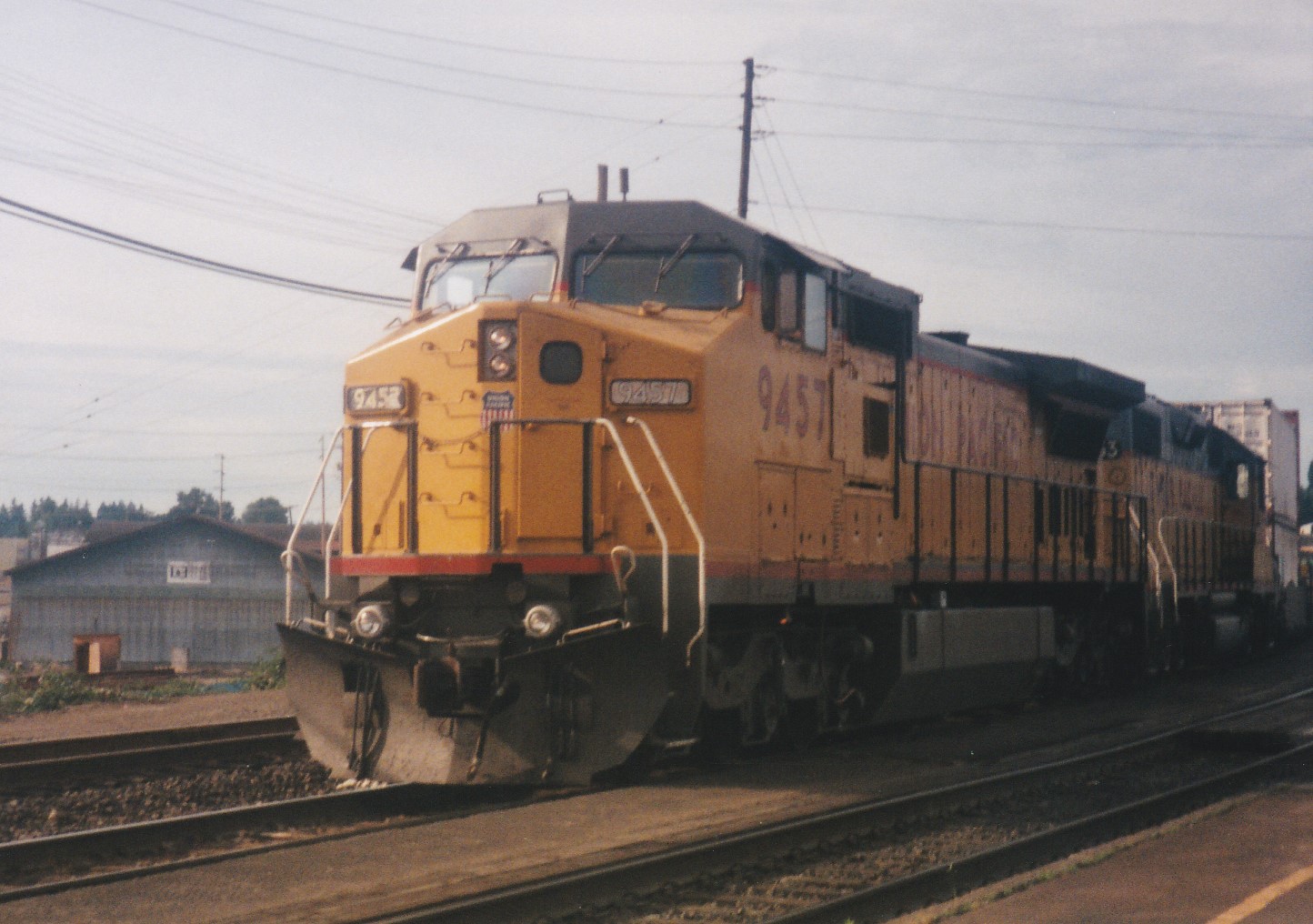
Union Pacific C41-8W #9457 in Vancouver, Washingon, on July 13, 1997

A southbound Union Pacific freight train passed through, led by Union Pacific #9457, a 4,135-horsepower Dash 8-41CW that was built by General Electric in October 1991 as a Dash 8-40CW. It was redesignated as a Dash 8-41CW in September 1993.

Amtrak B40-8P #808 in Vancouver, Washingon, on July 13, 1997

The next train to arrive was Amtrak's northbound Coast Starlight.

Amtrak B40-8P #808 in Vancouver, Washingon, on July 13, 1997

The Coast Starlight was led by Amtrak #808, a 4,000-horsepower Dash 8-40BP (or B40-8P) that was built by General Electric in May 1993.

Union Pacific C44-9W #9736 in Vancouver, Washingon, on July 13, 1997

Following the Coast Starlight was a northbound Union Pacific freight train, led by Union Pacific #9736 is a 4,380-horsepower Dash 9-44CW that was built by General Electric in August 1994.

BNSF GP38-2 #2099 in Vancouver, Washingon, on July 13, 1997

We saw BNSF #2099 get underway and head north, so we got into the car and hurried to the grade crossing at 39th Street.

BNSF GP38-2 #2099 in Vancouver, Washingon, on July 13, 1997

This was a great opportunity for more pictures of this unique unit as is slowly passed by with its freight train.

BNSF GP38-2 #2099 in Vancouver, Washingon, on July 13, 1997

Even some relatively close-up detail pictures were possible.

BNSF GP38-2 #2099 in Vancouver, Washingon, on July 13, 1997

The low afternoon sun really lit up the orange paint and yellow striping.

Burlington Northern GP39M #2889 in Vancouver, Washingon, on July 13, 1997

While we waited for BNSF #2099's northbound train to clear the crossing, a southbound freight train came along, led by Burlington Northern #2889, a GP39M that was originally built by the Electro-Motive Division of General Motors in February 1964 as Southern Pacific GP35 #6551. It was retired by Southern Pacific on November 15, 1990, and sold to Morrison-Knudsen on April 1, 1991, where it was rebuilt as BN GP39M #2889 and completed on August 20, 1991.

Burlington Northern SD40-2 in Kalama, Washingon, on July 13, 1997

After the freight trains cleared the 39th Street grade crossing, we raced to Kalama, Washington, for another chance to photograph BNSF #2099. While we waited on the Oak Street Overpass, a southbound BNSF freight train came through, led by a Burlington Northern SD40-2, whose number I can't make out due to the speed of the train and the low light.

BNSF GP38-2 #2099 in Kalama, Washingon, on July 13, 1997

BNSF #2099 arrived with its northbound freight train, speeding through Kalama.

BNSF GP38-2 #2099 in Kalama, Washingon, on July 13, 1997

The train was going so fast that in this picture, only the front of the locomotive is in focus.

Between the setting sun and the fact that we were almost home, we gave up the chase here.