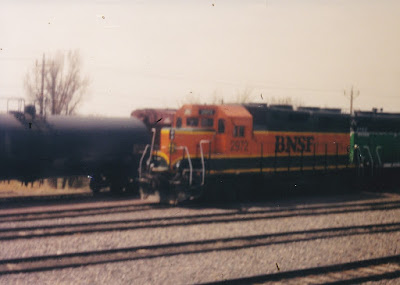
Burlington Northern Santa Fe #2972 was originally built by the Electro-Motive Division of General Motors in March 1964 as Gulf, Mobile & Ohio #601, a 2,500-horsepower GP35. On August 10, 1972, the Gulf, Mobile and Ohio Railroad merged with the Illinois Central Railroad to form the Illinois Central Gulf Railroad, and this locomotive was assigned Illinois Central Gulf #2500, but this number was never applied before it was sold in the spin-off of the new Paducah & Louisville Railway on August 27, 1986, remaining as #601. It was later sold to VMV Enterprises of Paducah, Kentucky, where it was rebuilt into 2,300-horsepower GP39V Burlington Northern #2972 in October 1990. Following the merger of the Burlington Northern and the Atchison, Topeka & Santa Fe on September 22, 1995, this locomotive became Burlington Northern Santa Fe #2972 and was repainted in Burlington Northern Santa Fe's "Heritage I" paint scheme on October 24, 1999. I photographed it from Amtrak’s westbound Empire Builder at Havre, Montana, on May 18, 2002.
Sunday, March 6, 2022
Trains in Portland & Vancouver in March 2002
My dad, Cliff West, took these pictures around March of 2002.
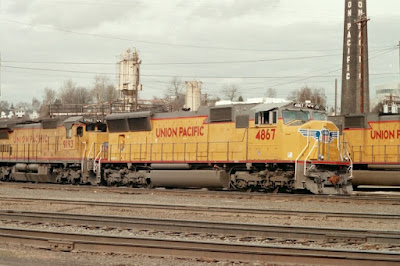
First, at Union Pacific’s Albina Yard in Portland, Oregon, Union Pacific SD70M #4867 is a 4,000-horsepower SD70M that was assembled by Bombardier Inc. in Sahagun, Mexico, for the General Motors Locomotive Group in January 2002.
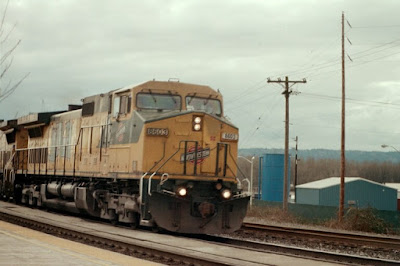
Moving to the Amtrak depot in Vancouver, Washington, Chicago & North Western #8603 is a 4,380-horsepower Dash 9-44CW that was built by General Electric in November 1993. The Chicago & North Western was merged into the Union Pacific on April 24, 1995.
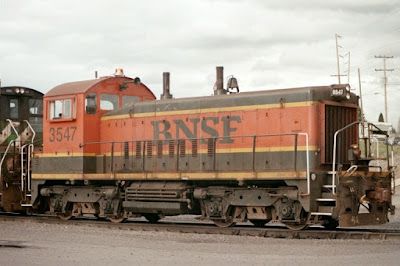
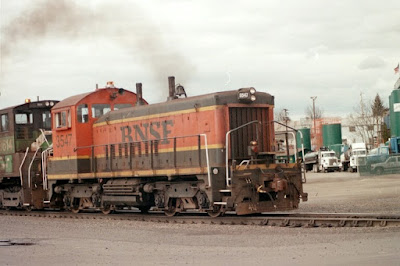
Burlington Northern Santa Fe #3547 was built by the Electro-Motive Division of General Motors in April 1957 as Great Northern 1,200-horsepower SW1200 #31. After the Great Northern was merged into the Burlington Northern on March 2, 1970, it became Burlington Northern #163 and was classified as an SW12.
Following the merger of the Burlington Northern and the Atchison, Topeka & Santa Fe on September 22, 1995, this locomotive became Burlington Northern Santa Fe #3547 in July 1998.
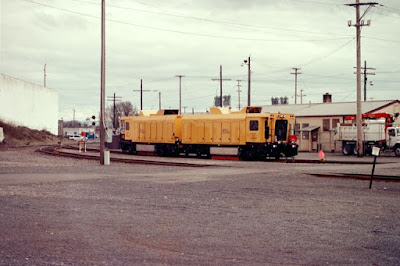
This is a Harsco Track Technologies RGH10C Rail Grinder. It uses independently adjustable grinder heads to restore the profile of the rail and remove irregularities to extend rail life, reduce wear on equipment, and reduce fuel use. Harsco is a company based in Harrisburg, Pennsylvania, with a history that dates back to 1853, when it was founded as the Harrisburg Car Manufacturing Company. It became Harrisburg Steel Corporation in 1935, and in 1956 it became Harsco Corporation with three divisions: Metals & Minerals, Rail, and Industrial. In 1979, Harsco Corporation merged with Fairmont Railway Motors, Inc., founded in 1905 by Frank E. Wade as Fairmont Machine Company, a small machine shop in Fairmont, Minnesota. Fairmont began producing small single cylinder engines in 1907, and was incorporated in 1909 and began to manufacture handcar-like rail vehicles powered by the two-cycle engines. Fairmont Railway Motors became Fairmont Gas Engine and Railway Motor Car Company in 1915, and then became Fairmont Railway Motors, Inc. in 1923. Fairmont acquired Mudge & Company of Chicago, another railway motor car business, in 1928. In 1940, Fairmont developed HY-RAIL® attachments to allow automobile and trucks to be used on rails as well as roads, and in 1955, Fairmont acquired the railcar interests of Fairbanks-Morse. In 1992, Harsco Corporation acquired Tamper Corporation, which was founded in Canada in 1934, creating Fairmont Tamper. In 1999, the Pandrol Jackson Company was merged with Fairmont Tamper to form Harsco Track Technologies. Pandrol Jackson had been formed in 1990, when Pandrol International, which in 1980 had formed a North American rail grinding joint venture with Speno Rail Services, acquired a 75% interest in ultrasonic rail flaw detection company Dapco Industries, as well as a controlling interest in Jackson-Jordan, Inc., which was created when Jackson Vibrators of Ludington, Michigan purchased the O.F. Jordan Company. Corwill Jackson founded the Electric Tamper & Equipment Company in Ludington, Michigan, in 1923, and created the electric vibrating hand tamper. Electric Tamper & Equipment Company was incorporated as Jackson Vibrators in 1937. In 1960, the O.F. Jordan Company was purchased by Jackson Vibrators of Ludington, Michigan, forming the Jackson-Jordan Company. The O.F. Jordan Company was founded by Oswald Falcus Jordan in 1898 to produce Jordan spreaders based on his 1891 patent with Robert Potts in Chicago, Illinois.
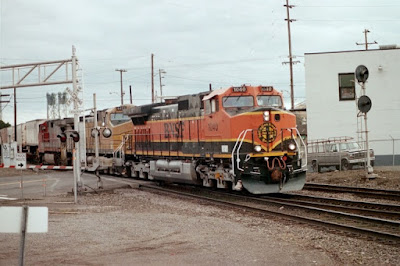
Burlington Northern Santa Fe #1040 is a 4,400-horsepower Dash 9-44CW that was built by General Electric in October 1996.
Saturday, June 20, 2020
Trains in Kalama, Washington, and Portland, Oregon, in December 2001
My dad, Cliff West, and I took these pictures in December 2001. First, we spotted this pair of lease units in Kalama, Washington, on our way to Portland, Oregon.
CEFX #113 is a 4,300-horsepower SD9043MAC that was built by the General Motors Locomotive Group and assembled at Super Steel Schenectady, Inc. in Schenectady, New York, in November 1999 for CIT Group/Capital Finance, Inc. for lease service.
CEFX #110 is also a 4,300-horsepower SD9043MAC that was built by the General Motors Locomotive Group and assembled at Super Steel Schenectady, Inc. in Schenectady, New York, in November 1999 for CIT Group/Capital Finance, Inc. for lease service.
![]() |
| Photo by Cliff West |
![]() |
| Photo by Cliff West |
![]() |
| Photo by Cliff West |
![]() |
| Photo by Cliff West |
Union Pacific #4593 is a 4,000-horsepower SD70M that was built by the General Motors Locomotive Group in London, Ontario, in April 2001.
![]() |
| Photo by Cliff West |
Union Pacific #4526 is a 4,000-horsepower SD70M that was built by the General Motors Locomotive Group in London, Ontario, in October 2001. Along with sister units #4527 and #4528, this was one of the first three Union Pacific locomotives to receive the large American flag decals and the new “Building America” slogan following the terrorist attacks of September 11, 2001.
![]() |
| Photo by Cliff West |
The three units entered service on November 14, 2001, and were unveiled on November 16, 2001. At the time of this photo, they were still the only three “flag” units on the Union Pacific, making this surprise sighting an incredible stroke of luck. Additional “flag” units would begin to be delivered in January 2002, featuring a slightly different flag decal from that used on these first three units.
Trains in Vancouver ,Washington, in December 2001
I took these pictures at the Amtrak depot in Vancouver, Washington, on December 23, 2001, after arriving on the Portland Section of Amtrak’s westbound Empire Builder. Union Pacific #3161 is a 3,000-horsepower SD40-2 that was built by the Electro-Motive Division of General Motors in February 1972.
Canadian Pacific #9124 is a 4,300-horsepower SD9043MAC that was built in December 1998 by General Motors Locomotive Group and assembled at Canadian Pacific’s Ogden Shops in Calgary, Alberta, Canada.
Canadian Pacific #5954 is a 3,000-horsepower SD40-2 that was built by the Diesel Division of General Motors of Canada, Ltd. In London, Ontario, in October 1980.
Canadian Pacific SD40-2F #9009 built by the Diesel Division of General Motors of Canada, Ltd. in 1988 in London, Ontario. It is one of only 25 built, all for Canadian Pacific. Nicknamed “red barns,” they were the only cowl-body diesels on the Canadian Pacific. They were built to SD40-2 specifications at Canadian Pacific’s request, despite the fact that regular SD40-2 production had ended several years earlier and competitor Canadian National had already purchased SD50Fs.
Amtrak Empire Builder at Minot, North Dakota, in December 2001
I took these pictures of Amtrak’s westbound Empire Builder during its service stop in Minot, North Dakota, on December 22, 2001.
Amtrak #150 is a 4,250-horsepower P42DC that was built by General Electric in March 2001.
Amtrak #148 is another 4,250-horsepower P42DC that was built by General Electric in February 2001.
Amtrak Baggage Car #1761 was originally built by Budd in 1953 as Atchison, Topeka & Santa Fe 48-Seat Coach #2860. After the formation of Amtrak in 1971 it became Amtrak #4872. It was converted to Head-End Power in June 1980 and was renumbered to Amtrak #4737. In October 1996 it was rebuilt into Amtrak Baggage-Mail Car #1719. In April 2000 it was converted to a mail-only configuration and renumbered as Amtrak #1761.
Tuesday, May 5, 2020
Trains in Vancouver and Portland in October 2001
![]() |
| Photo by Cliff West |
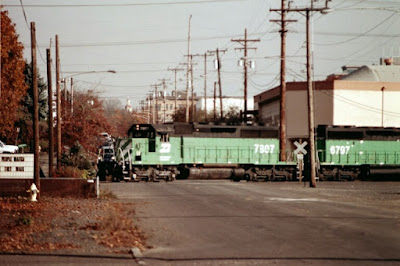
This group of pictures was taken by my dad, Cliff West, in October of 2001 at the Amtrak depot in Vancouver, Washington, and at Union Pacific’s Albina Yard in Portland, Oregon. We begin in Vancouver with Burlington Northern #7807, a 3,000-horsepower SD40-2 that was built by the Electro-Motive Division of General Motors in June 1977 as Colorado & Southern #937. Colorado & Southern was a subsidiary of Burlington Northern, and its locomotives were painted in Burlington Northern colors, but they had their own numbering system. These locomotives began to be renumbered in the Burlington Northern’s main numbering system in December 1978, and this locomotive became Colorado & Southern #7807. The Colorado & Southern was formally merged into the Burlington Northern on December 31, 1981, and this locomotive became Burlington Northern #7807. Following the merger of the Burlington Northern and the Atchison, Topeka & Santa Fe on September 22, 1995, this locomotive became Burlington Northern Santa Fe #7807.
![]() |
| Photo by Cliff West |
These four Chicago & North Western 100-Ton 5,250-Cubic-Foot 4-Bay Covered Hoppers at the Great Western Malting Company at the Port of Vancouver are part of a group of 100 numbered #490000 to #490999 that were built by Thrall between September 1993 and April 1994. These were some of the last freight cars built for the Chicago & North Western, and they became much more common in the Pacific Northwest after the Chicago & North Western was merged into the Union Pacific on April 24, 1995.
![]() |
| Photo by Cliff West |
Burlington Northern Santa Fe #7336 was originally built by General Motors Diesel, Ltd. in London, Ontario, in December 1968 as Canadian National #5075, a 3,000-horsepower SD40. It was retired in 1999 and was rebuilt by Alstom to an SD40-2 on October 5, 1999, and became Burlington Northern Santa Fe #7336, one of a group of 40 former Canadian National and Grand Trunk Western SD40s that became Burlington Northern Santa Fe #7300 to #7339.
![]() |
| Photo by Cliff West |
Atchison, Topeka & Santa Fe #853 is a 4,000-horsepower Dash 8-40CW that was built by General Electric in October 1992.
![]() |
| Photo by Cliff West |
It was still somewhat rare at this point to see older locomotives that had been repainted in Burlington Northern Santa Fe's "Heritage I" paint scheme, so here are some more pictures of Burlington Northern Santa Fe SD40-2 #7336.
![]() |
| Photo by Cliff West |
The motive power consist for this freight train represented the 1995 merger of the Burlington Northern and the Atchison, Topeka & Santa Fe, with a BNSF-painted locomotive leading a locomotive in Burlington Northern's Cascade Green and a locomotive in Santa Fe's Blue & Yellow "Warbonnet."
![]() |
| Photo by Cliff West |
It is interesting that despite being recently rebuilt for BNSF service in 1999, this unit did not have its headlight moved from the cab to the short hood following the Santa Fe's practice that BNSF continued.
![]() |
| Photo by Cliff West |
Burlington Northern #7052 is a 3,000-horsepower SD40-2 that was built by the Electro-Motive Division of General Motors in April 1978. Though this locomotive's BN paint scheme has not been modified yet, it has had its headlight moved from the cab to the short hood .
![]() |
| Photo by Cliff West |
Moving on to Albina Yard in Portland, we see Union Pacific #5762, a 4,400-horsepower AC4400CW that was built by General Electric in March 2001. Union Pacific refers to this locomotive as a C44ACCTE, to make the model designation correspond to the form introduced by General Electric with the “Dash 7” line of 1977, and to indicate that this locomotive is equipped with General Electric’s “Controlled Tractive Effort” software, which limits maximum tractive effort when the locomotive is used as a distributed power unit in the middle or at the rear of a train.
![]() |
| Photo by Cliff West |
Union Pacific #4011 is a 4,000-horsepower SD70M that was built by the General Motors Locomotive Group in London, Ontario, and was delivered on July 31, 2000.
![]() |
| Photo by Cliff West |
Southern Pacific #67342 is a O-100-7 Class 23,500-Gallon Tank Car built by American Car & Foundry at Milton, Pennsylvania, in early 1974, part of a group of 50 numbered #67300 to #67349.
![]() |
| Photo by Cliff West |
Union Pacific #8725 is a 3,000-horsepower SD40T-2 that was built by the Electro-Motive Division of General Motors in December 1978 as Southern Pacific #8525. After the Southern Pacific was merged into the Union Pacific on September 11, 1996, this locomotive became Union Pacific #4455 on November 23, 1997. It was renumbered to Union Pacific #8725 on May 6, 2001.
![]() |
| Photo by Cliff West |
Finally, Union Pacific #4203 is a 4,000-horsepower SD70M that was assembled by Bombardier Inc. in Sahagun, Mexico, for the General Motors Locomotive Group in August 2000.
Sunday, June 2, 2019
Trains at Portland's Albina Yard in Spring 2001
![]() |
| Photo by Cliff West |
This group of pictures were taken by my dad, Cliff West, while railfanning with Fred Anderson at Union Pacific's Albina Yard in Portland, Oregon, in the spring of 2001, I believe in the month of May. First we see a Union Pacific locomotive switching some Canadian Pacific covered hoppers featuring the beaver herald that was revived in 2007.
![]() |
| Photo by Cliff West |
Union Pacific #1598 is a 1,500-horsepower GP15-1 that was built by the Electro-Motive Division of General Motors in July 1977 as Missouri Pacific #1598. It retained its original number after the Missouri Pacific was merged into the Union Pacific in 1982, and was repainted in Union Pacific colors on November 7, 1988.
![]() |
| Photo by Cliff West |
Here is a Union Pacific freight train arriving at Albina Yard with four Union Pacific locomotives.
![]() |
| Photo by Cliff West |
The lead locomotive is Union Pacific #4626, a 4,000-horsepower SD70M that was built by the General Motors Locomotive Group in London, Ontario, in April 2001. It was only about a month old when this picture was taken.
![]() |
| Photo by Cliff West |
Also part of this locomotive consist, Union Pacific #4588 is another 4,000-horsepower SD70M that was built by the General Motors Locomotive Group in London, Ontario, in February 2001.
![]() |
| Photo by Cliff West |
Leading a departing freight train, Union Pacific #9054 is a 4,000-horsepower Dash 8-40C that was built by General Electric in August 1990 as Chicago & North Western #8532. Following the merger of the Chicago & North Western into the Union Pacific on April 25, 1995, this locomotive was renumbered and repainted for Union Pacific on December 5, 1995.
![]() |
| Photo by Cliff West |
The last picture from this group shows the freight train led by Union Pacific #9054 departing the Albina Yard as another freight train led by two more Union Pacific 4,000-horsepower EMD SD70Ms arrives in the yard.