Sunday, March 6, 2022

Trains in the Twin Cities in September 2002

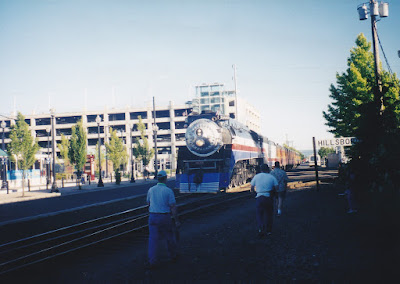
I took these pictures in St. Paul, Minnesota, on the morning of September 8, 2002, while traveling on Amtrak’s eastbound Empire Builder. St. Paul was a highlight for me, as the Minnesota Commercial and Soo Line equipment visible from the train seemed exotic to an Oregonian like me.
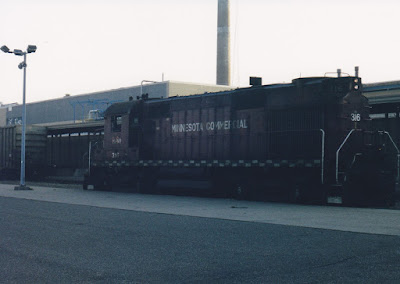
Minnesota Commercial RS-27 #316 at Midway Station in St. Paul, Minnesota on September 7, 2002

Switching at Amtrak’s Midway Station in St. Paul during the Empire Builder’s service stop, Minnesota Commercial #316 is a 2,400-horsepower RS-27 that was built by Alco Products in March 1962 as Chicago & North Western Railway #903.  Only 27 examples of the RS-27 were produced; the Chicago & North Western owned four, which were returned to Alco in 1966 in trade for C-424s. Alco leased them to various railroads in 1967 and 1968. This unit was sold to the Green Bay & Western in 1968 and became #316. It was later joined by two of the others. On August 27, 1993, the Green Bay & Western was merged with the Fox River Valley Railroad to form the Fox River & Western, a subsidiary of the Wisconsin Central, and this locomotive was sold to the Minnesota Commercial Railroad.

Puget Sound, Sierra Hotel & Caritas at Midway Station in St. Paul, Minnesota on September 7, 2002

Parked on a track at Midway Station were three privately-owned passenger cars, the Caritas, the Sierra Hotel, and the Puget Sound.
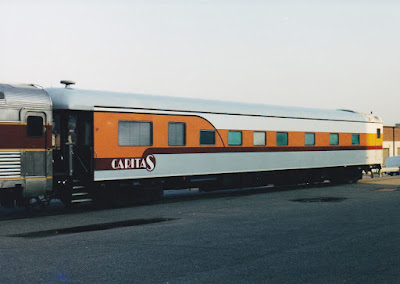
Caritas at Midway Station in St. Paul, Minnesota on September 7, 2002

The Caritas was built in 1948 by Pullman as a 4-Bedroom, 14-Roomette Sleeping Car for the St. Louis-San Francisco Railway, or Frisco for short. The car was originally named Pierre Laclede after the founder of St. Louis. The car was originally assigned to the Texas Special, which ran between St. Louis, Missouri, and San Antonio, Texas, over the Frisco and the Missouri-Kansas-Texas. The Frisco discontinued its portion of the Texas Special (the northern portion) in 1959. In 1964, this car was sold to the Canadian National and named Churchill FallsHigh Iron Travel bought the car in 1983 and rebuilt it to its current configuration, with 3 double bedrooms and a master room, dining area, galley, wine cellar, and lounge. I had seen the Caritas here before in 1999 wearing a red and white paint scheme; it had since been repainted in the same pattern but using Milwaukee Road colors, as shown here.

Sierra Hotel at Midway Station in St. Paul, Minnesota on September 7, 2002

Sierra Hotel was built by the Budd Company in October 1948 as Chicago, Burlington & Quincy #251 Silver Lounge for use on the California Zephyr between Chicago and Oakland. This mid-train Dome-Dormitory-Buffet-Lounge car originally included dormitory space for 15 crew members, a lounge under the dome that was remodeled into the “Cable Car Lounge” in 1964, and a buffet with seating for 19 passengers. After the Chicago, Burlington & Quincy was merged into the Burlington Northern on March 2, 1970, it became Burlington Northern #251. The California Zephyr made its last run on March 24, 1970, and when Amtrak took over passenger service on May 1, 1971 it was sold to become Amtrak #9811. It was used on Amtrak trains including the North Coast Hiawatha and the Texas Chief before being retired in October 1981 and being sold into charter service as Vandalia Railroad #9811. In 1989 the car was rebuilt by Midwest Railcar as open-end observation car Sierra Hotel. The open observation deck was built into what was originally the front of the car, so it now typically operates in the opposite direction of what was intended when it was built.

Puget Sound at Midway Station in St. Paul, Minnesota on September 7, 2002

Puget Sound was built by the Budd Company in June 1955 as Great Northern #1323 for use on the Empire Builder between Chicago and Seattle. It was originally built as a Great Dome coach with 46 revenue leg-rest seats plus seating for 24 people in the dome. After the Great Northern was merged into the Burlington Northern on March 2, 1970, it was assigned Burlington Northern #4603, but it did not receive this number before Amtrak took over passenger service on May 1, 1971 and it was sold to become Amtrak #9463. It was retired in 1985 and sold into private ownership and stored in Fargo, North Dakota, and Sault Ste Marie, Wisconsin, until being converted into sleeping car Puget Sound by Avalon Railcar in Milwaukee, Wisconsin, in 2000. As part of the rebuilding, its original smooth side panels were replaced with fluted panels to match Sierra Hotel.

Minnesota Commercial B23-7 #1978 at Minneapolis, Minnesota on September 7, 2002

Amtrak’s Empire Builder passes Minnesota Commercial’s nearby roundhouse in Minneapolis. Minnesota Commercial #1978 is a 2,250-horsepower B23-7 that was built by General Electric in April 1979 as Conrail #1978. It was retired in 1999 and sold to the Minnesota Commercial Railway, where it retained its original number.

Conrail B23-7 #2002 at Minneapolis, Minnesota on September 7, 2002

Conrail #2002 is a 2,250-horsepower B23-7 that was built by General Electric in August 1979. It was retired by Conrail in 1999 and was sold to the Minnesota Commercial Railroad, but has yet to be placed in service and still wears full Conrail paint and lettering.
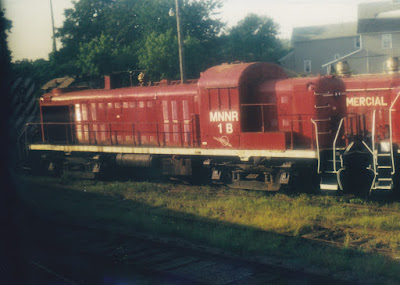
Minnesota Commercial RS3 #1B at Minneapolis, Minnesota on September 7, 2002

Minnesota Commercial #1B is a 1,600-horsepower RS3 that was built by the American Locomotive Company in September 1950 as Lake Superior & Ishpeming #1504 and was soon renumbered to #1604. It was retired in September 1989 and was sold to Clint Jones. It was sold to the Minnesota Commercial Railway in 1998 and was rebuilt as 1B in 1999.
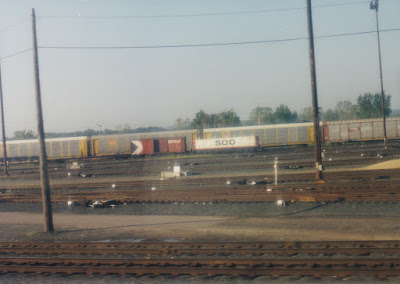
Soo Line Fuel Tender #4002 at Minneapolis, Minnesota on September 7, 2002

Soo Line #4002 is a Fuel Tender that was originally built by the Electro-Motive Division of General Motors in February 1958 as Milwaukee Road #2371, a 1,750-horsepower GP9. Milwaukee Road renumbered it to #263 before rebuilding it into “GP20” #949 in the 1970s. The Soo Line purchased the bankrupt Milwaukee Road in February 1985. The locomotive was rebuilt into Fuel Tender #4002 in November 1987. Coupled to it is a CP Rail 40-foot boxcar, which was rare to see in the 21st century. It is painted in the “Multimark” paint scheme, which was applied from 1968 to about 1987.

Soo Line Flatcar #954541 and Soo Line SW1500s #1400 & #1401 at Minneapolis, Minnesota on September 7, 2002

Soo Line Flatcar #954541 is a flatcar with an Operation Lifesaver display of crossing signals and an automobile involved in a grade crossing accident. Also pictured here are former Soo Line #1400 & #1401, 1,500-horsepower SW1500s that were built by the Electro-Motive Division of General Motors in November 1966 as Minneapolis, Northfield & Southern #36 & #37. The Minneapolis, Northfield & Southern was merged into the Soo Line on January 1, 1986. These were the only SW1500s on the Soo Line. They had been recently retired with their road numbers stricken out. Also pictured here is a Soo Line extended vision caboose. The road number is unclear but appears to be either #60 or #80. In either case, it was built by the International Car Company in 1973.
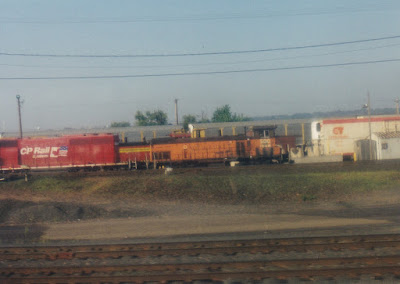
Soo Line MP15AC #1548 at Minneapolis, Minnesota on September 7, 2002

Soo Line MP15AC #1548 is a 1500-horsepower MP15AC that was built by the Electro-Motive Division of General Motors in September 1975 as Milwaukee Road #482. The Soo Line purchased the bankrupt Milwaukee Road in February 1985, and this locomotive became Soo Line #1548. It was never repainted into Soo Line colors and remains in its Milwaukee Road paint with its former road name and number painted out with black paint. Patched former Milwaukee Road locomotives on the Soo Line were known as “bandits.” In the background is one of four former North Louisiana & Gulf MP15DCs #42-45, built by the Electro-Motive Division of General Motors in November 1975, that has been acquired by CP Rail in 1996 and became CP Rail #1434-1437. The North Louisiana & Gulf was purchased by the MidSouth Rail Corporation on September 8, 1987, which operated it as the MidLouisiana Rail Corporation. On January 11, 1994, MidSouth was taken over by Kansas City Southern. Also (barely) visible is a Soo Line extended vision caboose in the later brown paint scheme.
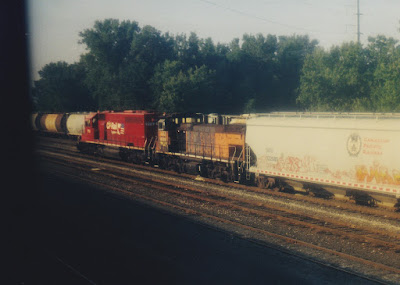
Soo Line MP15AC #1538 at Minneapolis, Minnesota on September 7, 2002

Soo Line MP15AC #1538 is another 1500-horsepower MP15AC that was built by the Electro-Motive Division of General Motors in September 1975 as Milwaukee Road #472. This MP15 was paired with CP Rail #776, a 3,000-horsepower SD40-2 built by the Electro-Motive Division of General Motors in October 1974 as Soo Line #776, for hump yard service at Pig’s Eye Yard in St. Paul. The Soo Line was consolidated into owner CP Rail in 1991, and in March 1993 SD40-2 #776 received the new CP Rail System paint scheme combining the American and Canadian flags, symbolizing CP Rail’s operations in both the United States and Canada.

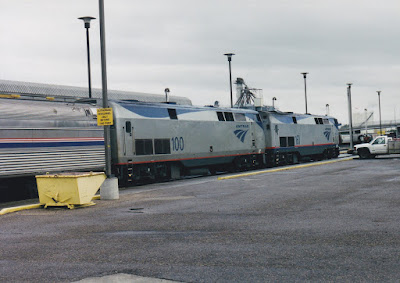
Trains in Havre, Montana in September 2002

I took these pictures in Havre, Montana, on September 7, 2002, while riding Amtrak’s eastbound Empire Builder.

Amtrak P42DCs #100 & #161 in Havre, Montana on September 7, 2002

Being serviced during the stop at the Havre depot, Amtrak P42DC #100 is a 4,250-horsepower P42DC that was built by General Electric in June 1997. It wears the newer version of Amtrak’s Phase V paint scheme, while lead P42DC #161, built in May 2001, wears the original version of the paint scheme with the higher “belt line.”

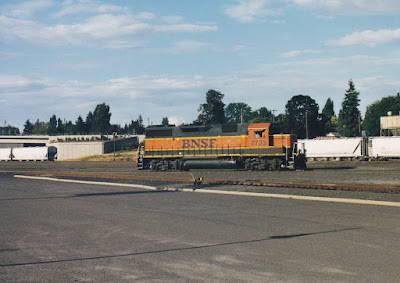
BNSF Dash 9-44CW in Havre, Montana on September 7, 2002

Back aboard Amtrak’s eastbound Empire Builder, this Burlington Northern Santa Fe Dash 9-44CW was sitting outside the Havre shops. The reflections in the windows of the Sightseer Lounge cars sometimes made it difficult to get a clear picture of things outside the train.

Burlington Northern C30-7 #5590 in Havre, Montana on September 7, 2002

Also at the Havre shops, Burlington Northern #5590 is a 3,000-horsepower C30-7 that was built by General Electric in June 1979.

BNSF SW1500 #3441 in Havre, Montana on September 7, 2002

Burlington Northern Santa Fe #3441 is a 1,500-horsepower SW1500 that was built by the Electro-Motive Division of General Motors in January 1973 as St. Louis-San Francisco (also known as the Frisco) #356. The Frisco was merged into the Burlington Northern on November 21, 1980, and this locomotive became Burlington Northern #61. Burlington Northern classified EMD’s SW1500s as SW15s. Following the merger of the Burlington Northern and the Atchison, Topeka & Santa Fe on September 22, 1995, this locomotive became Burlington Northern Santa Fe #3441 on February 19, 1998, and was repainted into Burlington Northern Santa Fe's "Heritage I" paint scheme on April 28, 2000.

Trains in Vancouver, Washington in September 2002

I took these pictures at the Amtrak depot in Vancouver, Washington, on September 6, 2002.

Amtrak Cascades F59PHI #466 in Vancouver, Washington on September 6, 2002

First, Amtrak Cascades #466 is a 3,200-horsepower F59PHI that was built in September 1998 by the Electro-Motive Division of General Motors with final assembly by Super Steel Schenectady of Schenectady, Pennsylvania. It is leading southbound Cascades train #753 into the Vancouver depot. This train was due at Vancouver at 4:47 PM.
Amtrak Cascades NPCU #90251 in Vancouver, Washington on September 6, 2002

Bringing up the rear of Cascades train #753 is Amtrak Cascades #90251, a Non-Powered Cab Unit, or NPCU, which was rebuilt in December 1998 from Amtrak #251, a 3,000-horsepower F40PHR that was built by the Electro-Motive Division of General Motors in October 1977 using parts from retired Amtrak SDP40F #575.

BNSF SD40-2 #8088 in Vancouver, Washington on September 6, 2002

Leading a westbound train from Portland toward the Columbia River Gorge, Burlington Northern Santa Fe #8088 is a 3,000-horsepower SD40-2 that was built by the Diesel Division of General Motors of Canada, Ltd. in August 1979 as Burlington Northern #8088. Following the merger of the Burlington Northern and the Atchison, Topeka & Santa Fe on September 22, 1995, this locomotive became Burlington Northern Santa Fe #8088 on April 20, 2001.

BNSF SD40-2 #7165 in Vancouver, Washington on September 6, 2002

Trailing is Burlington Northern Santa Fe #7165 is a 3,000-horsepower SD40-2 that was built by the Electro-Motive Division of General Motors in May 1979. 

BNSF SD40-2 #7165 in Vancouver, Washington on September 6, 2002

Following the merger of the Burlington Northern and the Atchison, Topeka & Santa Fe on September 22, 1995, this locomotive became Burlington Northern Santa Fe #7165 on September 10, 1998.

BNSF GP38-2 #2087 in Vancouver, Washington on September 6, 2002

Switching around the Vancouver depot, Burlington Northern Santa Fe #2087 is a 2,000-horsepower GP38-2 that was built by the Electro-Motive Division of General Motors in May 1972. Following the merger of the Burlington Northern and the Atchison, Topeka & Santa Fe on September 22, 1995, this locomotive became Burlington Northern Santa Fe #2087 and was repainted into Burlington Northern Santa Fe's "Heritage I" paint scheme on August 16, 2000.

BNSF SD40-2 #6841 in Vancouver, Washington on September 6, 2002

A consist of six BNSF road locomotives idled in the Vancouver yard near the depot. First is Burlington Northern Santa Fe #6841, a 3,000-horsepower SD40-2 that was built by the Electro-Motive Division of General Motors in July 1978 as St. Louis-San Francisco (also known as the Frisco) #951. The Frisco was merged into the Burlington Northern on November 21, 1980, and this locomotive became Burlington Northern #6841. Following the merger of the Burlington Northern and the Atchison, Topeka & Santa Fe on September 22, 1995, this locomotive became Burlington Northern Santa Fe #6841.

BNSF SD40-2 #6341 in Vancouver, Washington on September 6, 2002

Burlington Northern Santa Fe #6341 is a 3,000-horsepower SD40-2 that was built by the Electro-Motive Division of General Motors in November 1977 as Atchison, Topeka & Santa Fe #5026. Following the merger of the Burlington Northern and the Atchison, Topeka & Santa Fe on September 22, 1995, this locomotive became Burlington Northern Santa Fe #6341 on January 10, 1998, and was repainted into Burlington Northern Santa Fe's "Heritage I" paint scheme on February 17, 1999.

BNSF Dash 9-44CW #780 in Vancouver, Washington on September 6, 2002

Burlington Northern Santa Fe #780 is a 4,400-horsepower Dash 9-44CW that was built by General Electric in September 1997.

Atchison, Topeka & Santa Fe Dash 9-44CW #639 in Vancouver, Washington on September 6, 2002

Atchison, Topeka & Santa Fe #639 is a 4,400-horsepower Dash 9-44CW that was built by General Electric in February 1994.

BNSF Dash 9-44CW #4551 in Vancouver, Washington on September 6, 2002

Burlington Northern Santa Fe #4551 is a 4,400-horsepower Dash 9-44CW that was built by General Electric in September 1999.

BNSF Dash 9-44CW #989 in Vancouver, Washington on September 6, 2002

Burlington Northern Santa Fe #989 is a 4,400-horsepower Dash 9-44CW that was built by General Electric in August 1996.

BNSF GP39-2 #2733 in Vancouver, Washington on September 6, 2002

Burlington Northern Santa Fe #2733 is a 2,000-horsepower GP39-2 that was built by the Electro-Motive Division of General Motors in April 1981 as Burlington Northern #2733. Following the merger of the Burlington Northern and the Atchison, Topeka & Santa Fe on September 22, 1995, this locomotive became Burlington Northern Santa Fe #2733 and was repainted into Burlington Northern Santa Fe's "Heritage I" paint scheme on May 31, 2000.

BNSF SW1000 #3623 in Vancouver, Washington on September 6, 2002

Burlington Northern Santa Fe #3623 is a 1,000-horsepower SW1000 that was built by the Electro-Motive Division of General Motors in January 1971 as Burlington Northern #430 and classified as an SW10. Following the merger of the Burlington Northern and the Atchison, Topeka & Santa Fe on September 22, 1995, this locomotive became Burlington Northern Santa Fe #3623 on October 5, 1998.

BNSF Dash 9-44CW #989 in Vancouver, Washington on September 6, 2002

Here is another view of Burlington Northern Santa Fe #989 as the consist moved around the Vancouver yard.

BNSF SD40-2 #6341 in Vancouver, Washington on September 6, 2002

This additional view of Burlington Northern Santa Fe #6341 clearly shows the 123” “Snoot Nose” low short hood of this former Santa Fe unit. Santa Fe had 40 SD40-2s built with 123” low short hoods to contain radio equipment for Locotrol, a remote-control system for mid-train and rear helper locomotives. On the Santa Fe’s 40 equipped units, the even numbered units were “masters,” while the odd numbered units were “remotes.”

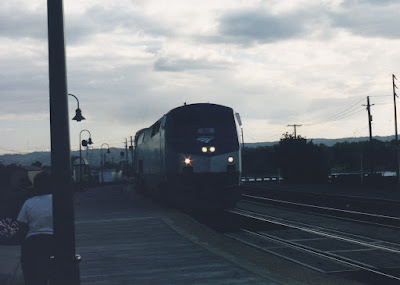
Amtrak P42DC #45 in Vancouver, Washington on September 6, 2002

Amtrak #45 is a 4,250-horsepower P42DC that was built by General Electric in January 1997. It is leading the northbound Coast Starlight, train #14, into Vancouver. The Coast Starlight was due into Vancouver at 4:23 PM, before Cascades train #753, but was apparently running late.

Amtrak Surfliner F59PHI in Vancouver, Washington on September 6, 2002

Trailing behind Amtrak P42DC #45 was an Amtrak F59PHI painted in Pacific Surfliner colors. The Pacific Surfliner service was established in 2000 between San Luis Obispo and San Diego, California, replacing the San Diegan service. A total of 15 of these 3,200-horsepower F59PHIs numbered 450 to 465 were built for Pacific Surfliner service in 1998 by the Electro-Motive Division of General Motors with final assembly by Super Steel Schenectady of Schenectady, Pennsylvania. Aside from the paint scheme, they were identical to the Cascades F59PHI locomotives numbered 466 to 470. All of Amtrak’s F59PHIs were maintained in Los Angeles. When the Cascades F59PHIs needed major maintenance, they had to be transported to Los Angeles via the Coast Starlight. This Pacific Surfliner F59PHI may have been being transferred to the Pacific Northwest to fill in for a Cascades unit in need of maintenance in Los Angeles.

BNSF Police Ford Explorer in Vancouver, Washington on September 6, 2002

This Burlington Northern Santa Fe Police Ford Explorer was stationed near the Amtrak depot. In an interesting coincidence, the officer driving this vehicle was the husband of my Spanish teacher from my Junior year of high school.

Amtrak P42DC #161 in Vancouver, Washington on September 6, 2002

Amtrak #161 is a 4,250-horsepower P42DC that was built by General Electric in May 2001. It is leading eastbound train #8, the Portland Section of the Empire Builder, into Vancouver. It was due into Vancouver at 5:07 PM. I would board this train for Milwaukee, Wisconsin.

ArTrain in Hillsboro, Oregon in June 2002

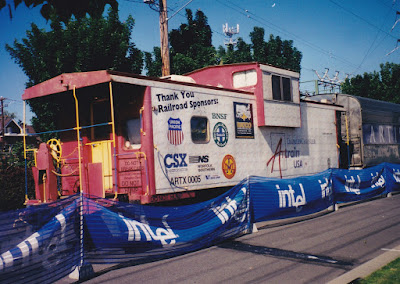
ArTrain Caboose ARTX #0005 in Hillsboro, Oregon in June 2002

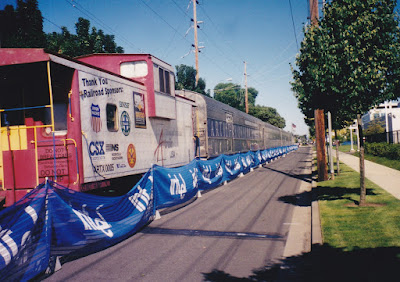
In 2002, the ArTrain was displayed in Hillsboro, Oregon, on the tracks of the Portland & Western in SW Washington Street from June 29 until July 4. ArTrain USA was founded in 1971 by the Michigan Council for the Arts in Ann Arbor, Michigan. Initially intended to operate only in Michigan, it began operating beyond Michigan in 1973. The train made three-year tours of the continental United States to display art exhibits in towns across the country. This exhibit was called “The Artistry of Space,” a collection of 78 pieces of NASA artwork from the Smithsonian Air & Space Museum in Washington DC and the Kennedy Space Center in Florida by artists such as Andy Warhol, Norman Rockwell, Peter Max, and Robert Rauschenberg among others.

Since its founding in 1971, the ArTrain has used a variety of rail equipment. In 2002 the ArTrain consisted of four converted streamlined passenger cars and a caboose. The ArTrain cars were purchased from Illinois Transit Assembly. Three of the passenger cars were used as gallery cars while the fourth served as the gift shop and studio. The caboose was used as an office for the onboard staff and as an apartment for a staff member while the train was in transit.

ArTrain in Hillsboro, Oregon in June 2002

ARTX #101 was built by the Budd Company in December 1948 as a sleeping car for the New York Central. It was originally named Missouri Valley and featured 10 roomettes and six double bedrooms. It was part of a group of cars that were originally assigned to the New England States, the Ohio State Limited, the Southwestern Limited, as well as general service. In 1950, the New York Central assigned five-digit numbers to all of its lightweight sleeping cars, although the numbers weren’t actually applied to the cars until after they had been withdrawn from Pullman service in 1958. This car was assigned #10136. It became Penn Central #4276, and then Amtrak #2836.

ARTX #102 and #103 were built by the Budd Company in July 1949 for the Pennsylvania Railroad. Each car formed one part of a twin-unit dining-kitchen-dormitory car. Seven such twin-unit dining-kitchen-dormitory cars were built and assigned to the Broadway Limited, the General, and other trains. Each unit consisted of a 68-seat dining table car with a four seat waiting room, and a kitchen car with dormitory space for 19 crew members. While designed to operate as a set, the units were separate cars and not articulated. The cars were numbered 4610-4623; the dining units had even numbers and the dormitory-kitchen cars had odd numbers. ARTX #102 was originally Pennsylvania Dormitory-Kitchen Car #4621. It later became Penn Central #4621 and then Amtrak #8805. ARTX #103 was originally Pennsylvania Dining Table Car #4618, and was later Penn Central #4618.

ARTX #104 was built by the Budd Company in September 1947 for the New York Central as Baggage-Dormitory Car #8976. It was retired in 1968 and sold to Ringling Brothers and Barnum & Bailey Circus. It went to the New Orleans Chapter of the National Railway Historical Society in the 1980s, then to the Seminole Gulf Railway in 1989.

ArTrain Caboose ARTX #0005 was built in 1971 as Detroit, Toledo & Ironton #141. The Detroit, Toledo & Ironton was acquired by the Grand Trunk Western in 1980, and was merged into the Grand Trunk Western in 1983. ArTrain acquired the caboose from Grand Trunk Western in 1994.

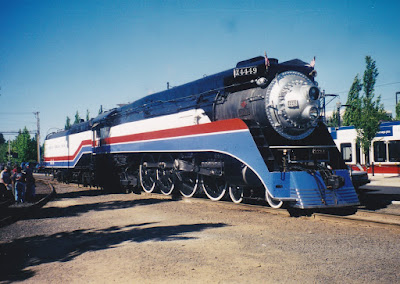
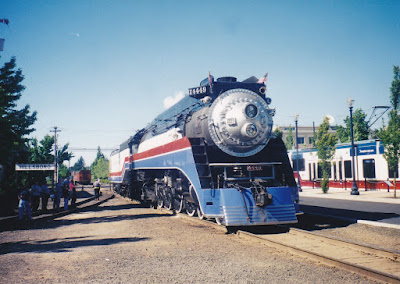
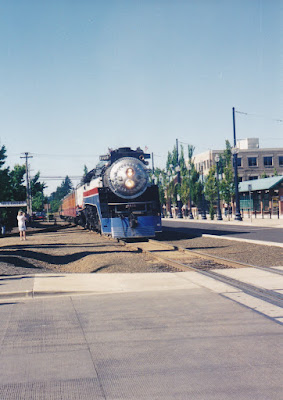
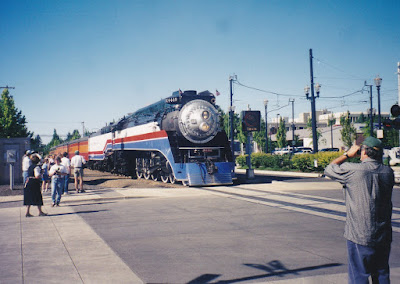
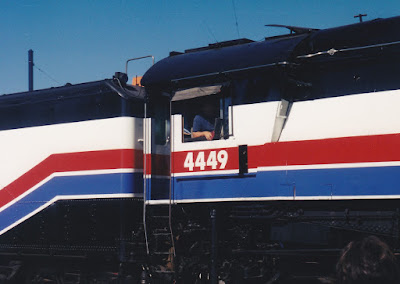
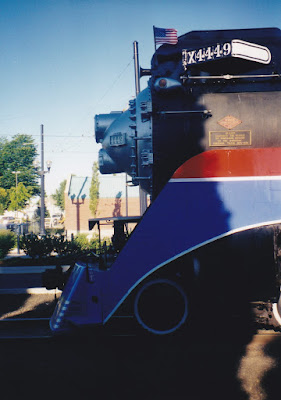
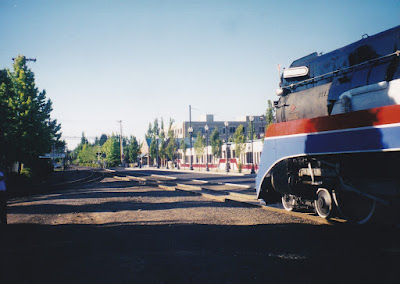
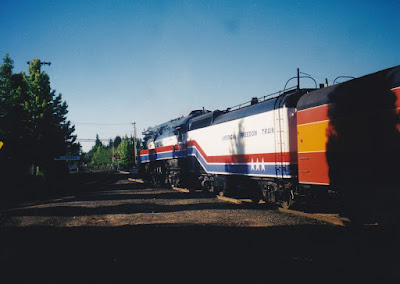
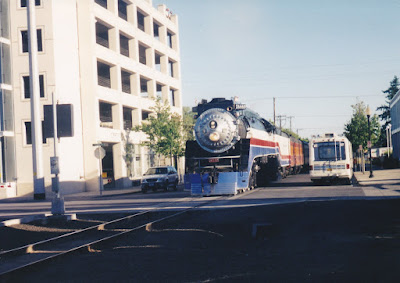
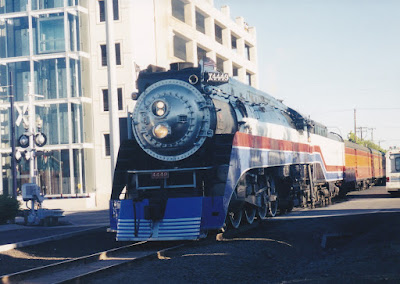
American Freedom Train GS-4 4-8-4 #4449 in Hillsboro, Oregon in June 2002

The ArTrain was pulled from Brooklyn Yard to downtown Hillsboro by 4449 on June 28. 4449 remained in Hillsboro until the end of the ArTrain’s exposition on July 4.

American Freedom Train GS-4 4-8-4 #4449 in Hillsboro, Oregon in June 2002

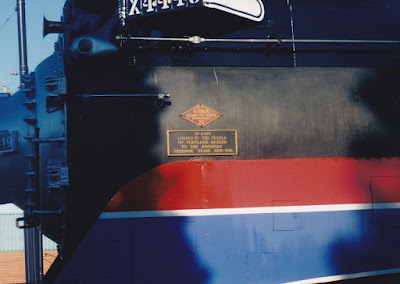
A member of the fourth type of Southern Pacific's "General Service" or "Golden State" 4-8-4 locomotives (the GS-4 Class), it was built in 1941 for glamorous service pulling Southern Pacific's premier Daylight streamlined passenger trains in Southern California, it too found itself replaced by diesels and was retired on October 2, 1957 and donated to the City of Portland, Oregon on April 24, 1958 and placed on display at Oaks Park with SP&S #700 and Union Pacific #3203. It would be the only Daylight steam locomotive to survive (though similar Southern Pacific non-streamlined GS-6 Class 4-8-4 #4460 also survives and is on display at the National Museum of Transport in Kirkwood, Missouri, it never wore Daylight colors). While in the park, a railroad employee named Jack Holst voluntarily kept the moving parts of the three locomotives oiled until his death in 1972. This would set the stage for #4449's resurrection.

American Freedom Train GS-4 4-8-4 #4449 in Hillsboro, Oregon in June 2002

In the early 1970s, as America's Bicentennial approached, Ross Rowland, Jr., with help from actor John Wayne, began planning a steam-powered museum train of American artifacts called the American Freedom Train that would travel the United States in celebration of the Bicentennial in 1976. By 1973, the project was underway, but a locomotive still had to be chosen. A number of locomotives were considered, including Union Pacific #8444, but in the end, Southern Pacific #4449 was selected to be the American Freedom Train's primary locomotive. On December 14, 1974, #4449 was removed from Oaks Park and moved to Burlington Northern's Hoyt Street Roundhouse near Union Station for restoration.

American Freedom Train GS-4 4-8-4 #4449 in Hillsboro, Oregon in June 2002

Though #4449 would actually be one of three steam locomotives that pulled the Freedom Train, it would become the most famous, at it pulled the train throughout the American Midwest and West. Former Reading Railroad #2101 (as AFT #1) was used in the east and former Texas & Pacific #610 was used in Texas. The Freedom Train opened in Wilmington, Delaware on April 1, 1975. As it was in the east, it began its tour with the AFT #1. Meanwhile, newly restored #4449's boiler is put to steam on April 18 for the first time since 1957. She moves under her own power on April 21, and was christened on May 16. She left Portland on June 20 to take over the Freedom Train in Chicago on August 4, after display stops in Sacramento and Ogden (and an unfortunate encounter with a dump truck in Nebraska). #4449 will pull the Freedom Train for the rest of its tour until it ends in Miami on December 31, 1976, except for a brief period in the fall of 1975 when the Freedom Train was pulled by diesels while #4449 was undergoing repairs, about a month in February-March 1976 when Texas & Pacific #610 pulls the Freedom Train in Texas, and four months in the summer when it is pulled on the East Coast again by AFT #1. After the Freedom Train tour, #4449 returned to Portland by pulling a series of Amtrak excursions across the South and West in April, 1977, still in its Freedom Train paint but with the "Amtrak" name added to the tender. This was known as the "Amtrak Transcontinental Steam Excursion." #4449 arrived in Portland on May 1, having visited at least 30 states (many more than once) during its Freedom Train and Amtrak Excursion travels, and was placed in storage, although this time it would be stored indoors, protected from the elements.

For more information about the American Freedom Train, visit The Museum of America's Freedom Trains.

American Freedom Train GS-4 4-8-4 #4449 in Hillsboro, Oregon in June 2002

In 1981, #4449 emerged, restored to the post-WWII version of its Daylight paint (with "SOUTHERN PACIFIC " in large lettering in the orange band) to travel to Railfair at the newly-opened California State Railroad Museum in Sacramento. It would retain this paint scheme for nearly 20 years (far longer than it had worn it while in regular service & even longer than the locomotive had even been IN regular service), as its travels included a trip to New Orleans to promote the 1984 World's Fair, a trip to Hollywood to be featured in the 1986 motion picture Tough Guys, a trip to Los Angeles to be a guest at the 50th Anniversary of the Los Angeles Union Passenger Terminal in 1989, additional trips to Sacramento for the 1991 and 1999 Railfairs, and numerous excursions in the Pacific Northwest.

In 2000, #4449 had the opportunity to pull Burlington Northern Santa Fe's Employee Appreciation Special. As BNSF didn't want to have a locomotive painted for one of the predecessors of its competition, #4449 had to be painted black with white pinstripes and BNSF heralds for the trip. After the BNSF trip, the black scheme was modified to recall the all-black paint applied during World War II as a cost saving measure and to make locomotives less visible in the event of an aerial attack by the enemy.

In 2002, rather than retuning to Daylight paint, #4449 returned to its American Freedom Train paint in remembrance of the September 11, 2001 terrorist attacks.

American Freedom Train GS-4 4-8-4 #4449 in Hillsboro, Oregon in June 2002

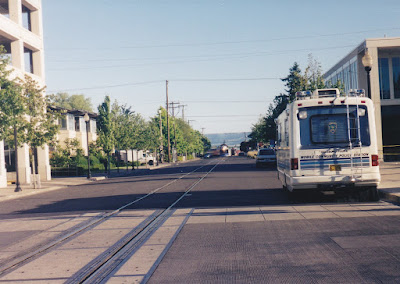
During the ArTrain’s exposition, #4449 made at least one short excursion run along the Portland & Western rail line south down SW Adams Street to at least the wye junction with the line between Beaverton and Forest Grove.

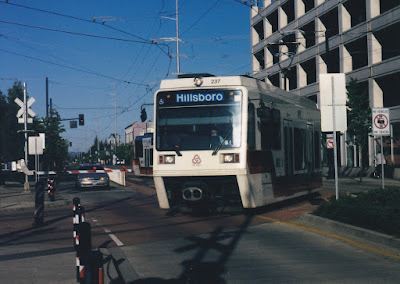
TriMet MAX Type 2 Siemens SD-660 #237 in Hillsboro, Oregon in June 2002

The ArTrain was displayed near the end of the Westside Line of TriMet’s MAX light rail system. The line to Hillsboro opened on September 12, 1998. In conjunction with the opening of the Westside Line, MAX also introduced its new Type 2 light rail cars numbered 201 to 252. These Siemens SD-660 light rail vehicles began operation on August 31, 1997, and were the first low-floor light rail vehicles in North America. Pictured here is TriMet MAX Type 2 Siemens SD-660 #237 turning across the westbound lane of SW Washington Street toward the Hillsboro station.

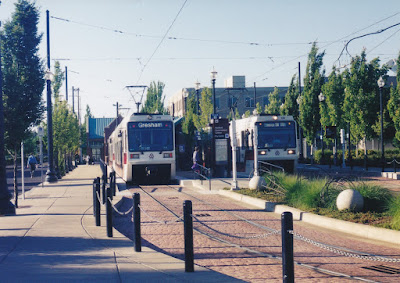
TriMet MAX Type 2 Siemens SD-660 #245 & #228 in Hillsboro, Oregon in June 2002

The end of the Westside Line is the Hatfield Government Center station, adjacent to the Washington County Courthouse, the Hillsboro Civic Center, and the Hillsboro Post Office. TriMet MAX Siemens SD-660 light rail vehicles #245 and #228 are pictured here at the Hatfield Government Center station.

American Freedom Train GS-4 4-8-4 #4449 in Hillsboro, Oregon in June 2002

Having turned at the Hillsboro wye, #4449 returned with its train. This train consisted of the Yes, Dear, the Clackamas River, and the Plum Creek. DLMX #5811, Yes, Dear, was originally Union Pacific RPO/Postal Storage Car #5811. It was one of three built by American Car & Foundry in 1949. Union Pacific transferred it to maintenance of way service as #903672 in 1973. It was sold to Doyle McCormack for use as #4449’s tool car in 1985. DLMX #9201, the Clackamas River, was built in 1941 for the Southern Pacific, Union Pacific and Chicago & North Western's City of San Francisco as 10 roomette-5 bedroom sleeper Rincon Hill. It was transferred to SP in 1947 as #9201 & was retired in 1966. The Friends of SP 4449 acquired it in 1990 from a private individual in North Dakota for use as #4449’s crew sleeper. Though an SP car, the Daylight paint isn't correct as it was only used on day trains, not sleeping cars.

American Freedom Train GS-4 4-8-4 #4449 in Hillsboro, Oregon in June 2002

American Freedom Train GS-4 4-8-4 #4449 in Hillsboro, Oregon in June 2002

American Freedom Train GS-4 4-8-4 #4449 in Hillsboro, Oregon in June 2002

American Freedom Train GS-4 4-8-4 #4449 in Hillsboro, Oregon in June 2002

American Freedom Train GS-4 4-8-4 #4449 in Hillsboro, Oregon in June 2002

American Freedom Train GS-4 4-8-4 #4449 in Hillsboro, Oregon in June 2002

American Freedom Train GS-4 4-8-4 #4449 in Hillsboro, Oregon in June 2002

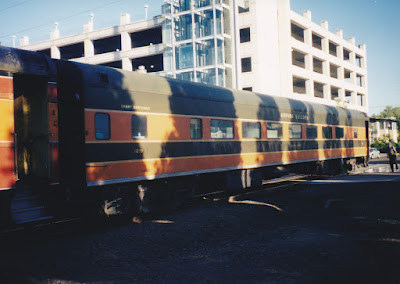
DLMX Coach #1210 Plum Creek in Hillsboro, Oregon in June 2002

DLMX #1210, Plum Creek, was built in 1950 by American Car & Foundry for the Great Northern Railroad. It was originally a 60-seat, short-distance coach. 1210 is the car's original number. Unlike many passenger cars, this coach was not sold to Amtrak and remained with the Great Northern's successor, Burlington Northern, who removed the coach seats in 1977 to use the car as a mobile classroom, though the car's original overhead luggage racks and lighting remain. In 1981, the car was sold and was kept in Minnesota, where it was named Plum Creek, until 1999, when it was purchased by the Friends of SP #4449 for use as a parlor/lounge car. Though it wears its original number of 1210, the car's official number, which can be found in small lettering on the side of the car, is PPCX #800235. It is maintained in its original Omaha Orange and Pullman Green of the Great Northern Railroad.

American Freedom Train GS-4 4-8-4 #4449 in Hillsboro, Oregon in June 2002

Also nearby, but not part of the train, was DLMX #5659, Gordon N. Zimmerman, aka PPCX #800634, in service as a concession car. It was built by American Car & Foundry in April, 1954 as Union Pacific Baggage Car #5659. It was renumbered to UP #24427 in April 1969 and to UP Maintenance of Way #904227 in 1975. It was purchased from Union Pacific by the Friends of SP #4449 in July, 1997. It initially operated in light gray paint with a black roof and wore the name Better Idea. It was later painted in Daylight colors and renamed Gordon N. Zimmerman, after a crew member who has been an active volunteer co-coordinating and selling souvenirs on every SP #4449 trip since 1981 and helping to restore 1937 Daylight car SP #3300, former UP mail car #5811, now #4449's tool car and #9201 Clackamas River, #4449's crew sleeper. The Gordon N. Zimmerman was making its debut with #4449 at the ArTrain display.