Saturday, March 26, 2022

Riding Amtrak's Westbound Empire Builder in May 2003

 I took these pictures while riding Amtrak’s westbound Empire Builder through Montana on May 24, 2003. The pictures begin with the train’s arrival in Havre, Montana.

Norfolk Southern C40-9W #9086 & BNSF SD40-2s #6730 & #7909 in Havre, Montana on May 24, 2003

As the train passed the Havre engine terminal, a variety of motive power could be seen. Norfolk Southern #9086 is a 4,000-horsepower Dash 9-40CW that was built by General Electric in March 1997. Burlington Northern Santa Fe #6730 is a 3,000-horsepower SD40-2 that was built by the Electro-Motive Division of General Motors in September 1979 as Atchison, Topeka & Santa Fe #5071. Following the merger of the Burlington Northern and the Atchison, Topeka & Santa Fe on September 22, 1995, this locomotive became Burlington Northern Santa Fe #6730 on January 20, 1998. Burlington Northern Santa Fe #7909 is a 3,000-horsepower SD40-2 that was built by the Electro-Motive Division of General Motors in June 1979 as Colorado & Southern #7909. Colorado & Southern was a subsidiary of Burlington Northern, and its locomotives were painted in Burlington Northern colors. The Colorado & Southern was formally merged into the Burlington Northern on December 31, 1981, and this locomotive became Burlington Northern #7909. Following the merger of the Burlington Northern and the Atchison, Topeka & Santa Fe on September 22, 1995, this locomotive became Burlington Northern Santa Fe #7909.

BNSF B40-8W #507 in Havre, Montana on May 24, 2003

Near the Havre shops, BNSF #507 is a 4,000-horsepower Dash 8-40BW that was built by General Electric in October 1990 as Atchison, Topeka & Santa Fe #507. Following the merger of the Burlington Northern and the Atchison, Topeka & Santa Fe on September 22, 1995, this locomotive became Burlington Northern Santa Fe #507 on May 8, 2001 and was repainted into Burlington Northern Santa Fe's "Heritage II" paint scheme on June 6, 2001.

Border Patrol Chevrolet Suburban M1717 & Great Northern S-2 4-8-4 #2584 in Havre, Montana on May 24, 2003

Havre is only 40 miles from the Canadian border, and the Border Patrol meets Amtrak's Empire Builder in Havre, to catch illegal aliens attempting to board the train.  As a result, there are often Border Patrol vehicles parked at the station.

Amtrak P42DC #152 in Havre, Montana on May 24, 2003

Leading the westbound Empire Builder, Amtrak #152 is a 4,250-horsepower P42DC that was built by General Electric in March 2001. It is wearing the first version of Amtrak’s “Phase V” paint scheme.

Amtrak P42DC #96 in Havre, Montana on May 24, 2003

Trailing is Amtrak #96 is a 4,250-horsepower P42DC that was built by General Electric in June 1997. It has been repainted with the new version of Amtrak’s “Phase V” paint scheme.

Hands Across the Border Park in Havre, Montana on May 24, 2003

The small Hands Across the Border Park at the Havre depot features a statue of an American Border Patrol officer shaking hands with a Royal Canadian Mounted Police officer.  

Great Northern S-2 4-8-4 #2584 in Havre, Montana on May 24, 2003

On display next to the depot in Havre is former Great Northern Railroad 4-8-4 steam locomotive #2584, an S-2 Class 4-8-4 that was built by the Baldwin Locomotive Works in 1930 and was put on static display next to the Have depot on May 15, 1964.  

Great Northern S-2 4-8-4 #2584 Sign in Havre, Montana on May 24, 2003

A sign next to the locomotive tells its history:

Great Northern S-2 4-8-4 #2584 in Havre, Montana on May 24, 2003

This Northern type locomotive, survivor of the last steam engines acquired by the Great Northern Railway for main-line passenger service, was placed on permanent exhibition here on May 15, 1964.

Great Northern S-2 4-8-4 #2584 in Havre, Montana on May 24, 2003

A powerful and speedy locomotive, this engine now looks every bit the aristocrat that it was during the yrs. of its pre-eminent association with the Empire Builder and the Oriental Limited. The Empire Builder was inaugurated in June, 1929, and was pulled by a Mountain type locomotive, but popularity of the train led to addition of cars to the consist, and this necessitated more powerful engines.

In 1930 Great Northern acquired 14 Class S-2 steam locomotives from Baldwin Locomotive Works for service on the Empire Builder and the Fast Mail trains. This engine – No 2584 - is the last of the 14 engines. Samuel Vauclain, President of Baldwin described the Class S-2 engines as "the finest, most powerful steam passenger locomotives ever built up to this time." These engines were operated in freight service after the Empire Builder was streamlines and diesel powered in 1947, and were retired in 1955.

Locomotive and tender are 103 feet 3 inches long, weight 764,680 pounds, and height from rail to top of stack is 16 feet. No 2584 was an oil burner and developed 58,305 pounds of tractive effort. Each of the 8 drive wheels is 80 inches high.

The track on which No 2584 stands is laid to Great Northern main line specifications. The creosoted ties are supported on a sub-ballast consisting of 6 inches of crushed rock chips and a ballast consisting of 6 inches of crushed pink quartzite rock. Both of which are quarried by the Great Northern in Montana. Welded rails fully tie plated and anchored, weight 115 pounds to the yard.

BNSF Railroad Depot in Havre, Montana on May 24, 2003

The depot in Havre, at 235 Main Street, is not only an Amtrak station; it also a local base of operation for Burlington Northern-Santa Fe freight operations and maintenance crews.  As a result, it is a large depot for a city of Havre's size.  The Burlington Northern Santa Fe was formed in 1995 when the Burlington Northern Railroad (successor to the Great Northern) and the Atchison, Topeka & Santa Fe Railroad merged together.  The station in Havre still showed signs of its Burlington Northern heritage with an apparent identity crisis. In front of the depot on the street side is a statue of James J. Hill. Hill formed the Great Northern Railroad in 1889 from the bankrupt St. Paul and Pacific Railroad, and extended it to Seattle by 1893. The commercial possibilities realized in the northern United States due to Hill's Great Northern Railway earned him the nickname of "The Empire Builder."

BNSF C44-9W #4716 in Havre, Montana on May 24, 2003

A consist of freight locomotives approached the Havre depot, led by Burlington Northern Santa Fe #4716, a 4,400-horsepower Dash 9-44CW that was built by General Electric in November 1997.

Norfolk Southern GP50 #7062 in Havre, Montana on May 24, 2003

The second unit is Norfolk Southern #7062, a 3,500-horsepower GP50 that was built by the Electro-Motive Division of General Motors in November 1980 as Southern Railway #7062. Following the merger of the Southern Railway and the Norfolk & Western in 1982, this locomotive became Norfolk Southern #7062.

Welcome to Havre Sign in Havre, Montana on May 24, 2003

A sign near the Havre railroad depot tells the story of Havre's early days.

WELCOME TO HAVRE
(pronounced Have'er)
The naming of Havre, according to William T. Cowan's memoirs.

The coming of the railroad in 1887 and '88 brought many workers and their families to Bull Hook Bottoms, later called Havre, according to William T. Cowan's memoirs.
The name Havre came from the following story:
"Two French-Canadian squatters on Bull Hook Bottoms were French Gus Descelles, a little sawed off man, and Joe De Mars, a very large, strong man.  They got in a fight over the affection of a charming girl and Joe De Mars got the best of the struggle.  Little French Gus reportedly said 'you can have her' and this is how Havre supposedly got it's name." The Great Northern Railway was the main supply line for Fort Assinniboine, located 5 miles southwest of Havre.  The railroad is still one of the main economic forces in the community.

BNSF Telecommunications Sign at the Depot in Havre, Montana on May 24, 2003

On the Havre depot is this handmade Telecommunications sign featuring a depiction of a General Electric Dash 9-44CW locomotive and the slogan “We Move Information.”

Rocky Mountains in Glacier National Park in Montana on May 24, 2003

As Amtrak’s Empire Builder continues west through Montana, it enters Glacier National Park and begins crossing the Rocky Mountains.

Rocky Mountains in Glacier National Park in Montana on May 24, 2003

Middle Fork of the Flathead River from the Java Trestle near Nimrod, Montana on May 24, 2003

The westbound Empire Builder eventually crosses the Middle Fork of the Flathead River near Nimrod, Montana on Java Trestle, at the point where Java Creek flows into Middle Fork of the Flathead River. This view from Java Trestle shows the clear blue water of the Middle Fork of the Flathead River.

Middle Fork of the Flathead River near Nimrod, Montana on May 24, 2003

The railroad passes through Snowshed #12, the last of a series of structures that protect the railroad from winter slides and avalanches. Just after leaving Snowshed #12 is this view of the Middle Fork of the Flathead River. The bridge carrying U.S. Highway 2 Bridge over the river is visible in the background.

Houses in Essex, Montana on May 24, 2003

As the train made its station stop in Essex, Montana, it passed a number of rustic residences.

BNSF Yard in Essex, Montana on May 24, 2003

There is a small Burlington Northern Santa Fe rail yard at Essex where helper locomotives and maintenance equipment can be found.

Izaak Walton Inn in Essex, Montana on May 24, 2003

Adjacent to the yard is the Izaak Walton Inn. Named after English writer Izaak Walton, for whom the Walton Ranger Station in Glacier National Park is also named, the inn was built on railroad property in 1939 in three months at a cost of $40,000 by the Addison Miller Company, which also operated it under contract for the Great Northern Railway as lodging for railway workers. Measuring 36 feet by 114 feet, the Tudor Revival inn featured 29 guest rooms, 10 bathrooms, a lobby, dining room, kitchen with a two-ton stove, drying room, store room and general store. 

Izaak Walton Inn in Essex, Montana on May 24, 2003

Located at the south end of Glacier National Park 27 miles from West Glacier and 30 miles from East Glacier, it was anticipated that Essex would become a southern gateway to Glacier National Park, however World War II prevented that development. With the inn never living up to its tourism potential, the Addison Miller Company sold it to Harry Stowell in 1965 for $5,000. George A. Walker purchased it in 1968. Sid and Millie Goodrich bought it in 1973. Larry and Linda Vielleux acquired it in 1982. The inn was added to the National Register of Historic Places on October 18, 1985, and was renovated in 1995 with bathrooms added to every guestroom.

Middle Fork of the Flathead River near Essex, Montana on May 24, 2003

West of Essex, Montana, the route of Amtrak's Empire Builder parallels U.S. Highway 2, which featured red-tinted pavement near Nyack, Montana.

Middle Fork of the Flathead River near Pinnacle, Montana on May 24, 2003

Middle Fork of the Flathead River near Pinnacle, Montana on May 24, 2003

Middle Fork of the Flathead River near Pinnacle, Montana on May 24, 2003

Rocky Mountains in Glacier National Park in Montana on May 24, 2003

Rocky Mountains in Glacier National Park in Montana on May 24, 2003

Rocky Mountains in Glacier National Park in Montana on May 24, 2003

Rocky Mountains in Glacier National Park in Montana on May 24, 2003

In addition to U.S. Highway 2, Amtrak's Empire Builder also parallels the Middle Fork of the Flathead River as it skirts the south edge of Glacier National Park, as seen here near Nyack, Montana.

BNSF SD40-2 #7868 at Nyack, Montana on May 24, 2003

At Nyack, Montana, there is a wye for turning helper locomotive consists. Here we see Burlington Northern Santa Fe #7868, a 3,000-horsepower SD40-2 that was built by the Electro-Motive Division of General Motors in October 1978 as Colorado & Southern #7868. Colorado & Southern was a subsidiary of Burlington Northern, and its locomotives were painted in Burlington Northern colors. The Colorado & Southern was formally merged into the Burlington Northern on December 31, 1981, and this locomotive became Burlington Northern #7868. Following the merger of the Burlington Northern and the Atchison, Topeka & Santa Fe on September 22, 1995, this locomotive became Burlington Northern Santa Fe #7868.

Rocky Mountains in Glacier National Park in Montana on May 24, 2003

Middle Fork of the Flathead River at West Glacier, Montana on May 24, 2003

Kayaker on the Middle Fork of the Flathead River at West Glacier, Montana on May 24, 2003

Kayakers can sometimes be seen on the Middle Fork of the Flathead River.

Kayaker on the Middle Fork of the Flathead River at West Glacier, Montana on May 24, 2003

Travel Alberta Visitor Information Centre in West Glacier, Montana on May 24, 2003

As the Empire Builder makes its station stop at West Glacier, Montana, the Travel Alberta Visitors Information Centre on Going-to-the-Sun Road can be seen from the train. This centre features visitor information and interpretive displays promoting the Canadian province of Alberta, along with restrooms, telephones, and picnic areas.

Norfolk Southern SD60 #6707 at Whitefish, Montana on May 24, 2003

The trailing unit of a freight train in the BNSF yard in Whitefish, Montana, Norfolk Southern #6707 is a 3,800-horsepower SD60 that was built by the Electro-Motive Division of General Motors in August 1989 as Conrail #6852. Following the breakup of Conrail between Norfolk Southern and CSX Transportation on June 1, 1999, this locomotive was acquired by Norfolk Southern, becoming #6707, though it still wore its Conrail colors at this point.

Milwaukee Road Boxcar #4512 at Whitefish, Montana on May 24, 2003

Part of a freight train in the BNSF yard in Whitefish, Montana, Milwaukee Road #4512 is a boxcar that was built in 1972 and still wears its original paint over 30 years later, despite the bankrupt Milwaukee Road having been taken over by the Soo Line in February 1985.

Great Northern NW3 #181 at Whitefish, Montana on May 24, 2003

Making its station stop in Whitefish, Montana, Amtrak’s westbound Empire Builder stopped alongside Great Northern NW3 #181 in Whitefish, Montana. Built by the Electro-Motive Division of General Motors in March 1942 as Great Northern #5406, this 1,000-horsepower diesel locomotive was the last of the only seven NW3s built, all for the Great Northern. It was renumbered to #181 in 1943. 

Great Northern NW3 #181 at Whitefish, Montana on May 24, 2003

On August 30, 1965, the Great Northern sold #181 to Anaconda Aluminum in Columbia Falls, Montana, where it became their #900. When no longer needed, Anaconda Aluminum donated the locomotive to the Stumptown Historical Society in Whitefish, Montana. It was restored to Great Northern colors and placed on permanent static display next to the Whitefish depot on November 19, 1990.

BNSF GP38-2 #2257 at Whitefish, Montana on May 24, 2003

It was getting dark when Amtrak’s westbound Empire Builder departed Whitefish, Montana, but I was able to get one last photograph of a pair of Burlington Northern Santa Fe 4-axle EMD locomotives, only one of which can be identified. Burlington Northern Santa Fe #2257 is a 2,000-horsepower GP38-2 that was built by the Electro-Motive Division of General Motors in June 1973 as St. Louis-San Francisco (also known as the Frisco) #402. The Frisco was merged into the Burlington Northern on November 21, 1980, and this locomotive became Burlington Northern #2257. Following the merger of the Burlington Northern and the Atchison, Topeka & Santa Fe on September 22, 1995, this locomotive became Burlington Northern Santa Fe #2257 on April 25, 1998.

Sunday, March 20, 2022

Riding Amtrak's Westbound Empire Builder in December 2002

Old Soo Depot Transportation Museum in Minot, North Dakota on December 21, 2002

I took these pictures on December 21, 2002, while riding Amtrak’s westbound Empire BuilderThis historic depot was built in 1912 and once served the Minneapolis, St. Paul & Sault Ste. Marie Railroad, or Soo Line, which is now part of the Canadian Pacific Railway. This depot is no longer owned by the railroad. It is located in Minot's historic downtown district and houses the Old Soo Depot Transportation Museum.

Amtrak Depot in Minot, North Dakota on December 21, 2002

This depot is the one currently served by Amtrak. It is located just west of the old Soo Line depot, on the opposite side of the U.S. Highway 83 overpass. This depot was originally built in 1910 by the Great Northern Railway. A major renovation in 1975 replaced the original gabled roof with a flat roof, covered the original brick with stucco and remodeled the interior. Here Amtrak's Empire Builder can be seen making its station stop. Just to the north of the depot, on the other side of the tracks and past some trees, is the Souris River.

BNSF-CP Crossing in Minot, North Dakota on December 21, 2002

Just to the west of the Amtrak station, and visible from its platform, is crossing of the Burlington Northern-Santa Fe Railroad and the Canadian Pacific Railway. In this 2002 photo, Amtrak's Empire Builder is stopped on the BNSF track and the freight train crossing in front of it is on the CP track. This crossing is the busiest rail crossing in the state of North Dakota. The building visible behind the Canadian Pacific freight train is the Minot Public Library.

Amtrak F40PH #383 in Minot, North Dakota on December 21, 2002

During the Empire Builder’s service stop in Minot, North Dakota, I braved the winter snow to check out the motive power consist and discovered Amtrak #383, a 3,000-horsepower F40PHR that was built by the Electro-Motive Division of General Motors in July 1981 using parts from retired Amtrak SDP40F #518. It is painted to match the Pacific Surfliner equipment used in southern California between San Luis Obispo and San Diego.

BNSF SW1500 #3441 in Havre, Montana on December 21, 2002

Pictured in Havre, Montana, Burlington Northern Santa Fe #3441 is a 1,500-horsepower SW1500 that was built by the Electro-Motive Division of General Motors in January 1973 as St. Louis-San Francisco (also known as the Frisco) #356. The Frisco was merged into the Burlington Northern on November 21, 1980, and this locomotive became Burlington Northern #61. Burlington Northern classified EMD’s SW1500s as SW15s. Following the merger of the Burlington Northern and the Atchison, Topeka & Santa Fe on September 22, 1995, this locomotive became Burlington Northern Santa Fe #3441 on February 19, 1998, and was repainted in Burlington Northern Santa Fe's "Heritage I" paint scheme on April 28, 2000.

BNSF Dash 8-40B #8615 in Havre, Montana on December 21, 2002

Also in Havre near the shops, Burlington Northern Santa Fe #8615 is a 4,000-horsepower Dash 8-40B that was built by General Electric in June 1988 as Atchison, Topeka & Santa Fe #7425. Following the merger of the Burlington Northern and the Atchison, Topeka & Santa Fe on September 22, 1995, this locomotive became Burlington Northern Santa Fe #8615 on January 12, 2000, and was repainted in Burlington Northern Santa Fe’s “Heritage I” paint scheme on December 16, 2000.

Burlington Northern GP39M #2871 in Wishram, Washington on December 22, 2002

I took this picture the next day on December 22, 2002, while riding the Portland section of Amtrak’s westbound Empire Builder through Wishram, Washington. Unless running extremely late, the Empire Builder generally made an extended station stop in Wishram to allow cigarette smokers an opportunity to satisfy their addiction, as the smoking car was part of the train’s Seattle section. I merely turned my attention and my camera to the railroad equipment outside the window. Burlington Northern #2871 is a GP39M that was originally built by the Electro-Motive Division of General Motors in February 1964 as Southern Pacific #7452, a 2,500-horsepower GP35. After 1965 it was renumbered to Southern Pacific #6564. It was retired in January 1991 and was sold to Morrison-Knudsen of Boise, Idaho, who rebuilt it into 2,300-horsepower GP39M Burlington Northern #2871 in July 1991. With it is Burlington Northern Santa Fe #2083, a 2,000-horsepower GP38-2 that was built by the Electro-Motive Division of General Motors in May 1972 as Burlington Northern #2083. Following the merger of the Burlington Northern and the Atchison, Topeka & Santa Fe on September 22, 1995, this locomotive became Burlington Northern Santa Fe #2083 and was repainted in Burlington Northern Santa Fe's "Heritage I" paint scheme on October 2, 2000.

Monday, March 7, 2022

Trains in Butler & Milwaukee, Wisconsin, in December 2002

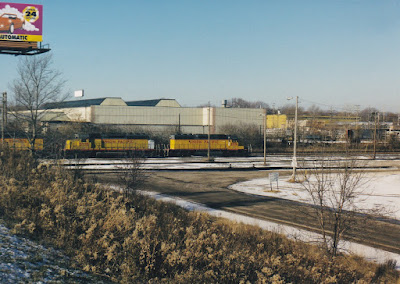
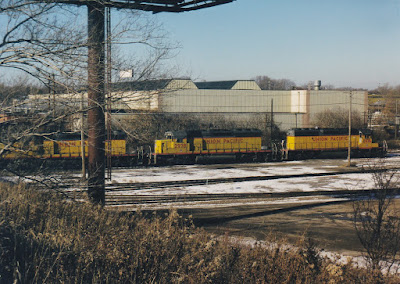
Union Pacific Yard in Butler, Wisconsin, on December 7, 2002

I took these pictures on December 7, 2002, during the Milwaukee School of Engineering Society of Model Engineers New Member Orientation Program Scavenger Hunt. 

Union Pacific Yard in Butler, Wisconsin, on December 7, 2002

One of the locations on the scavenger hunt was Union Pacific’s former Chicago & North Western yard in Butler, Wisconsin.

Union Pacific SD40-2 #2978 in Butler, Wisconsin, on December 7, 2002

Union Pacific #2978 is a 3,000-horsepower SD40-2 that was built by the Electro-Motive Division of General Motors in February 1974 as Chicago & North Western #6830. After the Chicago & North Western was merged into the Union Pacific on April 24, 1995, this locomotive became Union Pacific #2978 on August 11, 1997.

Union Pacific SD40-2 #2976 in Butler, Wisconsin, on December 7, 2002

Union Pacific #2976 is a 3,000-horsepower SD40-2 that was built by the Electro-Motive Division of General Motors in February 1974 as Chicago & North Western #6828. After the Chicago & North Western was merged into the Union Pacific on April 24, 1995, this locomotive became Union Pacific #2976 on April 3, 1998.
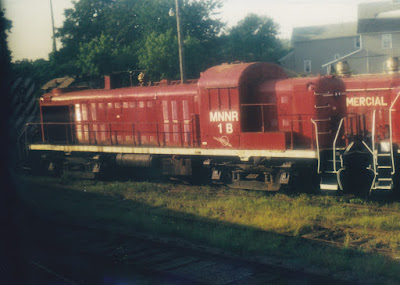
LLPX GP38-2 #2253 in Butler, Wisconsin, on December 7, 2002

LLPX #2253 is a 2,000-horsepower GP38-2 that was built by the Electro-Motive Division of General Motors in March 1977 as Long Island Railroad #275. It was retired between November 1999 and March 2000. 

LLPX GP38-2 #2253 in Butler, Wisconsin, on December 7, 2002

It ended up with General Motors’ Locomotive Leasing Partners and was subsequently leased to Union Pacific. It is painted in Union Pacific colors but without lettering and with its road numbers in a distinctly non-Union Pacific font.

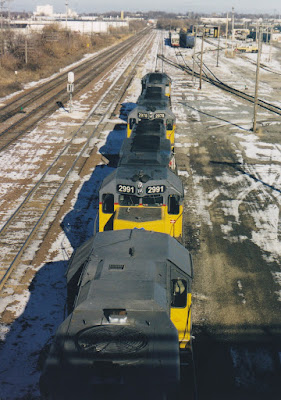
Union Pacific SD40-2 #2991 in Butler, Wisconsin, on December 7, 2002

Union Pacific #2991 is a 3,000-horsepower SD40-2 that was built by the Electro-Motive Division of General Motors in April 1974 as Chicago & North Western #6859. 

Union Pacific SD40-2 #2991 in Butler, Wisconsin, on December 7, 2002

After the Chicago & North Western was merged into the Union Pacific on April 24, 1995, this locomotive became Union Pacific #2991 on April 14, 1998.
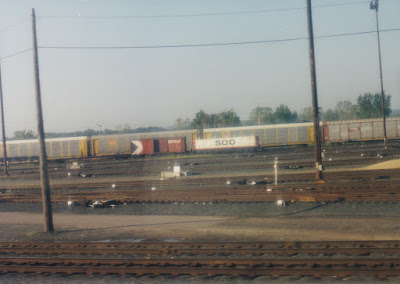
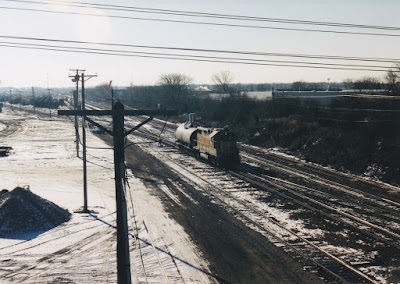
Union Pacific GP38-2 #393 in Butler, Wisconsin, on December 7, 2002

Union Pacific #393 is a 2,000-horsepower GP38-2 that was built by the Electro-Motive Division of General Motors in December 1979 as Chicago & North Western #4628. 
Union Pacific GP38-2 #393 in Butler, Wisconsin, on December 7, 2002

After the Chicago & North Western was merged into the Union Pacific on April 24, 1995, this locomotive became Union Pacific #393 on August 25, 2000.

Amtrak P42DC #57 in Milwaukee, Wisconsin, on December 7, 2002

Another location on the scavenger hunt was the Amtrak station in downtown Milwaukee, Wisconsin, where an Amtrak Hiawatha consist could be found under the trainshed. Amtrak #57 is a 4,250-horsepower P42DC that was built by General Electric in February 1997.

Sunday, March 6, 2022

Trains in the Columbia River Gorge in Fall 2002

This group of pictures was taken by my dad, Cliff West, while railfanning with Fred Anderson in the Columbia River Gorge in the fall of 2002. These Burlington Northern Santa Fe freight trains were seen in and just west of Wishram, Washington.

BNSF C44-9W #755 in Wishram, Washington in Fall 2002
Photo by Cliff West

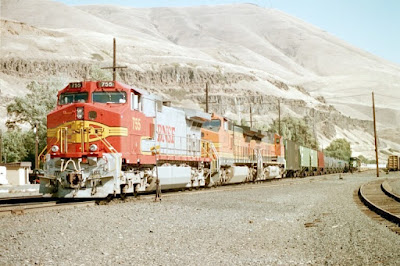
Burlington Northern Santa Fe #755 is a 4,400-horsepower Dash 9-44CW that was built by General Electric in August 1997. It is painted in the BNSF version of the Santa Fe “Warbonnet” colors with small initials on the long hood.

BNSF C44-9W #755 in Wishram, Washington in Fall 2002
Photo by Cliff West

This locomotive was part of the first order to be delivered in this variation.

BNSF C44-9W #4423 in Wishram, Washington in Fall 2002
Photo by Cliff West

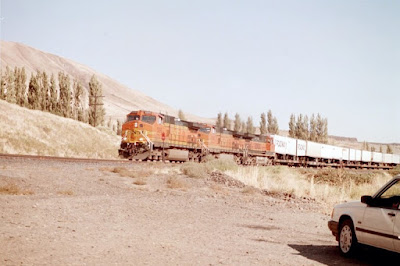
Burlington Northern Santa Fe #4423 is a 4,400-horsepower Dash 9-44CW that was built by General Electric in April 1999.

BNSF C44-9W #5298 in Wishram, Washington in Fall 2002
Photo by Cliff West

Burlington Northern Santa Fe #5298 is a 4,400-horsepower Dash 9-44CW that was built by General Electric in June 2001.

Spokane, Portland & Seattle F9A #802 at the Columbia Gorge Interpretive Center Museum in Fall 2002
Photo by Cliff West

A vintage diesel locomotive and caboose were under restoration for static display at the site of the Columbia Gorge Interpretive Center Museum in Stevenson, Washington. This locomotive was built by the Electro-Motive Division of General Motors in LaGrange, Illinois as a 1,750-horsepower F9A for the Northern Pacific Railway in March 1956. It was originally numbered #7013D and was a freight locomotive on the Northern Pacific Railway. In April 1965 it was reassigned to passenger service and renumbered #6704A, (taking the number of another 1956 F9A that had been reassigned to freight service and renumbered to #7052A in 1960). As #6704A, one of its assignments was to pull the Vista Dome North Coast Limited between Chicago and Seattle. The Northern Pacific became part of the Burlington Northern in March 1970, and the locomotive became Burlington Northern #9816. Amtrak took over passenger service in 1971 and the locomotive was reassigned back to freight service. In June 1973 it was renumbered to Burlington Northern #782. In December 1981 it was converted to Rotary Snowplow Power Unit (RSPU) #972569 and used in the Midwest. It was retired in 1998 and Burlington Northern Santa Fe donated the empty carbody to the Columbia Gorge Interpretive Center Museum for static display. The museum restored the unit as Spokane, Portland & Seattle Railway #802. The real SP&S #802 was an earlier 1,500-horsepower F3A built by the Electro-Motive Division of General Motors in November 1948. The Spokane, Portland & Seattle did not own any F9As. When SP&S became part of Burlington Northern, SP&S #802 became Burlington Northern #9752. In July 1972 it became Rotary Snowplow Power Unit #972551, but a locomotive shortage returned it to service as locomotive #9752 in 1974. It was renumbered to #712 in 1976 and was retired in November 1981 and scrapped.

Spokane, Portland & Seattle Caboose #701 at the Columbia Gorge Interpretive Center Museum in Fall 2002
Photo by Cliff West

The diesel locomotive is accompanied by this wooden caboose, which was built in 1947 for the Spokane, Portland & Seattle Railway as #701. It came to the Columbia Gorge Interpretive Center Museum before the locomotive.

Trains in the Twin Cities in September 2002

I took these pictures in St. Paul, Minnesota, on the morning of September 8, 2002, while traveling on Amtrak’s eastbound Empire Builder. St. Paul was a highlight for me, as the Minnesota Commercial and Soo Line equipment visible from the train seemed exotic to an Oregonian like me.

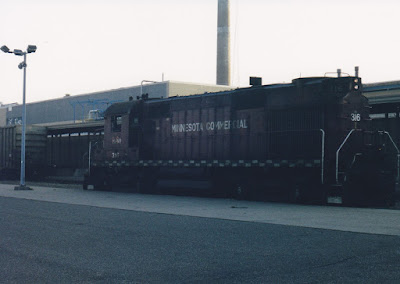
Minnesota Commercial RS-27 #316 at Midway Station in St. Paul, Minnesota on September 7, 2002

Switching at Amtrak’s Midway Station in St. Paul during the Empire Builder’s service stop, Minnesota Commercial #316 is a 2,400-horsepower RS-27 that was built by Alco Products in March 1962 as Chicago & North Western Railway #903.  Only 27 examples of the RS-27 were produced; the Chicago & North Western owned four, which were returned to Alco in 1966 in trade for C-424s. Alco leased them to various railroads in 1967 and 1968. This unit was sold to the Green Bay & Western in 1968 and became #316. It was later joined by two of the others. On August 27, 1993, the Green Bay & Western was merged with the Fox River Valley Railroad to form the Fox River & Western, a subsidiary of the Wisconsin Central, and this locomotive was sold to the Minnesota Commercial Railroad.

Puget Sound, Sierra Hotel & Caritas at Midway Station in St. Paul, Minnesota on September 7, 2002

Parked on a track at Midway Station were three privately-owned passenger cars, the Caritas, the Sierra Hotel, and the Puget Sound.

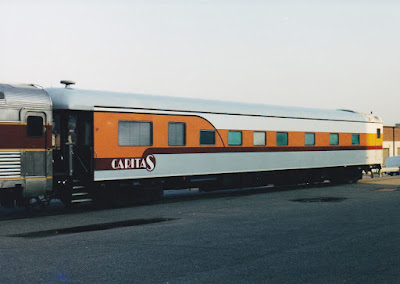
Caritas at Midway Station in St. Paul, Minnesota on September 7, 2002

The Caritas was built in 1948 by Pullman as a 4-Bedroom, 14-Roomette Sleeping Car for the St. Louis-San Francisco Railway, or Frisco for short. The car was originally named Pierre Laclede after the founder of St. Louis. The car was originally assigned to the Texas Special, which ran between St. Louis, Missouri, and San Antonio, Texas, over the Frisco and the Missouri-Kansas-Texas. The Frisco discontinued its portion of the Texas Special (the northern portion) in 1959. In 1964, this car was sold to the Canadian National and named Churchill FallsHigh Iron Travel bought the car in 1983 and rebuilt it to its current configuration, with 3 double bedrooms and a master room, dining area, galley, wine cellar, and lounge. I had seen the Caritas here before in 1999 wearing a red and white paint scheme; it had since been repainted in the same pattern but using Milwaukee Road colors, as shown here.

Sierra Hotel at Midway Station in St. Paul, Minnesota on September 7, 2002

Sierra Hotel was built by the Budd Company in October 1948 as Chicago, Burlington & Quincy #251 Silver Lounge for use on the California Zephyr between Chicago and Oakland. This mid-train Dome-Dormitory-Buffet-Lounge car originally included dormitory space for 15 crew members, a lounge under the dome that was remodeled into the “Cable Car Lounge” in 1964, and a buffet with seating for 19 passengers. After the Chicago, Burlington & Quincy was merged into the Burlington Northern on March 2, 1970, it became Burlington Northern #251. The California Zephyr made its last run on March 24, 1970, and when Amtrak took over passenger service on May 1, 1971 it was sold to become Amtrak #9811. It was used on Amtrak trains including the North Coast Hiawatha and the Texas Chief before being retired in October 1981 and being sold into charter service as Vandalia Railroad #9811. In 1989 the car was rebuilt by Midwest Railcar as open-end observation car Sierra Hotel. The open observation deck was built into what was originally the front of the car, so it now typically operates in the opposite direction of what was intended when it was built.

Puget Sound at Midway Station in St. Paul, Minnesota on September 7, 2002

Puget Sound was built by the Budd Company in June 1955 as Great Northern #1323 for use on the Empire Builder between Chicago and Seattle. It was originally built as a Great Dome coach with 46 revenue leg-rest seats plus seating for 24 people in the dome. After the Great Northern was merged into the Burlington Northern on March 2, 1970, it was assigned Burlington Northern #4603, but it did not receive this number before Amtrak took over passenger service on May 1, 1971 and it was sold to become Amtrak #9463. It was retired in 1985 and sold into private ownership and stored in Fargo, North Dakota, and Sault Ste Marie, Wisconsin, until being converted into sleeping car Puget Sound by Avalon Railcar in Milwaukee, Wisconsin, in 2000. As part of the rebuilding, its original smooth side panels were replaced with fluted panels to match Sierra Hotel.

Minnesota Commercial B23-7 #1978 at Minneapolis, Minnesota on September 7, 2002

Amtrak’s Empire Builder passes Minnesota Commercial’s nearby roundhouse in Minneapolis. Minnesota Commercial #1978 is a 2,250-horsepower B23-7 that was built by General Electric in April 1979 as Conrail #1978. It was retired in 1999 and sold to the Minnesota Commercial Railway, where it retained its original number.

Conrail B23-7 #2002 at Minneapolis, Minnesota on September 7, 2002

Conrail #2002 is a 2,250-horsepower B23-7 that was built by General Electric in August 1979. It was retired by Conrail in 1999 and was sold to the Minnesota Commercial Railroad, but has yet to be placed in service and still wears full Conrail paint and lettering.

Minnesota Commercial RS3 #1B at Minneapolis, Minnesota on September 7, 2002

Minnesota Commercial #1B is a 1,600-horsepower RS3 that was built by the American Locomotive Company in September 1950 as Lake Superior & Ishpeming #1504 and was soon renumbered to #1604. It was retired in September 1989 and was sold to Clint Jones. It was sold to the Minnesota Commercial Railway in 1998 and was rebuilt as 1B in 1999.

Soo Line Fuel Tender #4002 at Minneapolis, Minnesota on September 7, 2002

Soo Line #4002 is a Fuel Tender that was originally built by the Electro-Motive Division of General Motors in February 1958 as Milwaukee Road #2371, a 1,750-horsepower GP9. Milwaukee Road renumbered it to #263 before rebuilding it into “GP20” #949 in the 1970s. The Soo Line purchased the bankrupt Milwaukee Road in February 1985. The locomotive was rebuilt into Fuel Tender #4002 in November 1987. Coupled to it is a CP Rail 40-foot boxcar, which was rare to see in the 21st century. It is painted in the “Multimark” paint scheme, which was applied from 1968 to about 1987.

Soo Line Flatcar #954541 and Soo Line SW1500s #1400 & #1401 at Minneapolis, Minnesota on September 7, 2002

Soo Line Flatcar #954541 is a flatcar with an Operation Lifesaver display of crossing signals and an automobile involved in a grade crossing accident. Also pictured here are former Soo Line #1400 & #1401, 1,500-horsepower SW1500s that were built by the Electro-Motive Division of General Motors in November 1966 as Minneapolis, Northfield & Southern #36 & #37. The Minneapolis, Northfield & Southern was merged into the Soo Line on January 1, 1986. These were the only SW1500s on the Soo Line. They had been recently retired with their road numbers stricken out. Also pictured here is a Soo Line extended vision caboose. The road number is unclear but appears to be either #60 or #80. In either case, it was built by the International Car Company in 1973.

Soo Line MP15AC #1548 at Minneapolis, Minnesota on September 7, 2002

Soo Line MP15AC #1548 is a 1500-horsepower MP15AC that was built by the Electro-Motive Division of General Motors in September 1975 as Milwaukee Road #482. The Soo Line purchased the bankrupt Milwaukee Road in February 1985, and this locomotive became Soo Line #1548. It was never repainted into Soo Line colors and remains in its Milwaukee Road paint with its former road name and number painted out with black paint. Patched former Milwaukee Road locomotives on the Soo Line were known as “bandits.” In the background is one of four former North Louisiana & Gulf MP15DCs #42-45, built by the Electro-Motive Division of General Motors in November 1975, that has been acquired by CP Rail in 1996 and became CP Rail #1434-1437. The North Louisiana & Gulf was purchased by the MidSouth Rail Corporation on September 8, 1987, which operated it as the MidLouisiana Rail Corporation. On January 11, 1994, MidSouth was taken over by Kansas City Southern. Also (barely) visible is a Soo Line extended vision caboose in the later brown paint scheme.

Soo Line MP15AC #1538 at Minneapolis, Minnesota on September 7, 2002

Soo Line MP15AC #1538 is another 1500-horsepower MP15AC that was built by the Electro-Motive Division of General Motors in September 1975 as Milwaukee Road #472. This MP15 was paired with CP Rail #776, a 3,000-horsepower SD40-2 built by the Electro-Motive Division of General Motors in October 1974 as Soo Line #776, for hump yard service at Pig’s Eye Yard in St. Paul. The Soo Line was consolidated into owner CP Rail in 1991, and in March 1993 SD40-2 #776 received the new CP Rail System paint scheme combining the American and Canadian flags, symbolizing CP Rail’s operations in both the United States and Canada.

Trains in Havre, Montana in September 2002

I took these pictures in Havre, Montana, on September 7, 2002, while riding Amtrak’s eastbound Empire Builder.

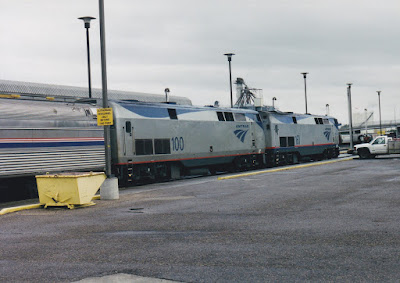
Amtrak P42DCs #100 & #161 in Havre, Montana on September 7, 2002

Being serviced during the stop at the Havre depot, Amtrak P42DC #100 is a 4,250-horsepower P42DC that was built by General Electric in June 1997. It wears the newer version of Amtrak’s Phase V paint scheme, while lead P42DC #161, built in May 2001, wears the original version of the paint scheme with the higher “belt line.”

BNSF Dash 9-44CW in Havre, Montana on September 7, 2002

Back aboard Amtrak’s eastbound Empire Builder, this Burlington Northern Santa Fe Dash 9-44CW was sitting outside the Havre shops. The reflections in the windows of the Sightseer Lounge cars sometimes made it difficult to get a clear picture of things outside the train.

Burlington Northern C30-7 #5590 in Havre, Montana on September 7, 2002

Also at the Havre shops, Burlington Northern #5590 is a 3,000-horsepower C30-7 that was built by General Electric in June 1979.

BNSF SW1500 #3441 in Havre, Montana on September 7, 2002

Burlington Northern Santa Fe #3441 is a 1,500-horsepower SW1500 that was built by the Electro-Motive Division of General Motors in January 1973 as St. Louis-San Francisco (also known as the Frisco) #356. The Frisco was merged into the Burlington Northern on November 21, 1980, and this locomotive became Burlington Northern #61. Burlington Northern classified EMD’s SW1500s as SW15s. Following the merger of the Burlington Northern and the Atchison, Topeka & Santa Fe on September 22, 1995, this locomotive became Burlington Northern Santa Fe #3441 on February 19, 1998, and was repainted into Burlington Northern Santa Fe's "Heritage I" paint scheme on April 28, 2000.