Friday, June 7, 2024

Albany & Eastern #2002 & #2001 at Lebanon, Oregon, on March 31, 2006

Albany & Eastern GP38-3 #2002 at Lebanon, Oregon, on March 31, 2006

I photographed this Albany & Eastern freight train at Lebanon, Oregon, on March 31, 2006. In the lead is Albany & Eastern #2001, which was built by the Electro-Motive Division of General Motors in February 1970 as Illinois Central #9502, one of an order of 20 2,000-horsepower GP38AC locomotives. In 1972, the Illinois Central merged with the Gulf, Mobile & Ohio to become the Illinois Central Gulf, and the locomotive became Illinois Central Gulf #9502. After their original 15-year lease expired, this was one of 18 of the 20 to be leased to the Missouri-Kansas-Texas in 1985, and it became MKT #327. The Missouri-Kansas-Texas was acquired by the Union Pacific, and the locomotive became Union Pacific #1984 on February 6, 1991. After the MKT lease expired, Union Pacific purchased it on October 23, 1996. It was renumbered to Union Pacific #1785 on August 27, 1997. It was assigned Union Pacific #285 in December 1999, but was retired by Union Pacific on May 25, 2001, before being renumbered. In 2002 it came to the Albany & Eastern as GP38-3 #2001.

Albany & Eastern GP38-3 #2001 at Lebanon, Oregon, on March 31, 2006
 

The trailing unit, Albany & Eastern #2002, was built by the Electro-Motive Division of General Motors in February 1970 as Illinois Central #9511, one of an order of 20 2,000-horsepower GP38AC locomotives. In 1972, the Illinois Central merged with the Gulf, Mobile & Ohio to become the Illinois Central Gulf, and the locomotive became Illinois Central Gulf #9511. After their original 15-year lease expired, this was one of 18 of the 20 to be leased to the Missouri-Kansas-Texas in 1985, and it became MKT #335. The Missouri-Kansas-Texas was acquired by the Union Pacific, and the locomotive became Union Pacific #1992 on March 6, 1991. After the MKT lease expired, Union Pacific purchased it on October 23, 1996. It was renumbered to Union Pacific #1792 on July 25, 1998. It was assigned Union Pacific #292 in December 1999, but was retired by Union Pacific on May 25, 2001, before being renumbered. In 2002 it came to the Albany & Eastern as GP38-3 #2002.

Union Pacific Freight Train at Albany, Oregon, on March 30, 2006

Union Pacific Freight Train at Albany, Oregon, in March 30, 2006

I photographed this southbound Union Pacific freight train from my car on Interstate 5 at Albany, Oregon, on March 30, 2006. Leading the train, Union Pacific #3888 is a 4,000-horsepower SD70M built by the General Motors Locomotive Group in London, Ontario, and was delivered on March 7, 2003. The second unit is Union Pacific #3188, a 3,000-horsepower SD40-2 built by the Electro-Motive Division of General Motors in July 1972. The third unit is a Union Pacific SD70M that appears to be #4067, which was built by the General Motors Locomotive Group in London, Ontario, and was delivered November 6, 2000. The fourth unit is a Union Pacific SD40-2 that appears to be #3222, which was built by the Electro-Motive Division of General Motors in May 1973.

Union Pacific SD40-2 #3319 at Albany, Oregon, in March 30, 2006

The trailing locomotive is Union Pacific #3319, a 3,000-horsepower SD40-2 built by the Electro-Motive Division of General Motors in July 1976 as Union Pacific #8049. This locomotive was originally one of Union Pacific’s “Fast Forties” with high-speed gearing for a top speed of 80 miles per hour. In July 1980 it was converted to standard gearing and renumbered to Union Pacific #3319.

Boxcars at Albany, Oregon, in March 30, 2006

Here are a couple of interesting boxcars that were part of this freight train. On the left is a boxcar from the Northern Alberta Railways. The Northern Alberta Railways was chartered in March 1929, combining the Edmonton, Dunvegan and British Columbia Railway, the Alberta and Great Waterways Railway, the Central Canada Railway and the Pembina Valley Railway into a joint subsidiary of the Canadian National Railway and Canadian Pacific Railway extending from Edmonton to McMurray and Hines Creek in Alberta and to Dawson Creek, British Columbia, and later connecting at Grimshaw, Alberta, with the Great Slave Lake Railway to Hay River, Northwest Territories, which opened in 1964 and was operated by Canadian National. On January 1, 1981, Canadian National bought out Canadian Pacific’s share in the Northern Alberta Railways and it was merged into CN. Thus, this boxcar dates to before 1981 and has not been repainted since then. Next to it is this former Golden West Service boxcar. Golden West Service started around 1990 using former Southern Pacific and Cotton Belt (SSW) freight cars that were sold to Greenbrier, refurbished by Gunderson, and leased back to Southern Pacific wearing the reporting marks of short line railroads. These cars were restored to their original reporting marks and road numbers when they were released from the arrangement in the early 2000s. Cotton Belt (SSW) boxcar #66220 is a class B-70-67 boxcar with two 8-foot sliding doors on each side and a capacity of 5,283 cubic feet that was built by FMC between April and June of 1973. It was refurbished for Golden West Service with GVSR reporting marks of the Galveston Railroad and numbered in the 767200-767258 or 767275-767291 series. It had since been restored to its original reporting marks and road number but still wore its Golden West Service paint scheme.

Thursday, June 6, 2024

MAX Trains near the Beaverton Creek Station

TriMet MAX Type 1 & Type 2 Light Rail Vehicles near the Beaverton Creek Station in Beaverton, Oregon, on March 28, 2006 

Beaverton Creek is a station on TriMet’s Westside MAX Blue Line in Beaverton, Oregon, between Portland and Hillsboro, which opened on September 12, 1998. This station features a Park and Ride lot and is near the Nike World Headquarters. I took these pictures of MAX light rail trains near the Beaverton Creek station on March 28, 2006.

TriMet MAX Type 2 & Type 1 Light Rail Vehicles near the Beaverton Creek Station in Beaverton, Oregon, on March 28, 2006

The car on the right is a MAX Type 1 light rail vehicle. A total of 26 MAX Type 1 cars numbered #101-126 were built by Bombardier Corporation in a joint venture with La Brugeoise et Nivelles (BN) of Belgium. They are based on a Brazilian Cobrasma design used under license by BN for a group of cars for Rio de Janeiro. Bombardier built the frames in Quebec, with 80% of the production and assembly in Barre, Vermont, and electrical propulsion equipment from Brown, Boveri & Company. The cars were delivered in 1984 and service began on September 5, 1986. The cars have 76 seats and a total capacity of 166 passengers. These original cars would be the only MAX cars not built by Siemens, the only high-floor MAX cars, and the only MAX cars that lack regenerative braking. When built, the cars featured bell cords and hand-cranked destination signs and lacked air conditioning, though all these features were changed over the years. Because of the high floors of these cars, wheelchair lifts had to be installed at every MAX station. Once the low-floor Type 2 and Type 3 MAX cars were delivered, the Type 1 cars always ran coupled to a low-floor car so the lifts could be eliminated.


TriMet MAX Type 2 Light Rail Vehicles near the Beaverton Creek Station in Beaverton, Oregon, on March 28, 2006

These two cars are MAX Type 2 light rail vehicles. A total of 52 MAX Type 2 Siemens SD600 cars numbered #201-252 were built from 1996 to 2000. They were the first low-floor light rail vehicles used in the United States and the first MAX cars delivered with air conditioning. They have a capacity of 166 passengers and were built with 72 seats, though 8 seats were removed later for bicycle storage. The initial 39 cars numbered 201-239 were ordered in May 1993 to expand the fleet for the Westside MAX Blue Line. The first car #201 was delivered in July 1996 and the first nine of these cars entered service on August 31, 1997. The initial order was expanded to 46 cars with cars 240-246 built by 1998. The order was expanded again to a total of 52 cars, with the final car being delivered in April 2000.

TriMet MAX Type 3 & Type 2 Light Rail Vehicles near the Beaverton Creek Station in Beaverton, Oregon, on March 28, 2006

The car on the left is a MAX Type 3 light rail vehicle. A total of 27 MAX Type 3 Siemens SD660 cars numbered #301-327 were built from 2003 to 2005. They have 64 seats and a capacity of 166 passengers. They are virtually identical to the Type 2 cars, but feature improved air conditioning, more ergonomic seats, and automatic photoelectric passenger counters. They were also delivered in Trimet’s new paint scheme that was introduced in 2002. These cars were purchased to expand the fleet for the new Interstate MAX Yellow Line from downtown Portland to the Portland Metropolitan Exposition Center in North Portland, which opened on May 1, 2004. The first of these cars was delivered in February 2003 and entered service in September 2003. The initial order was for 17 cars, with 10 more added to the order in 2002. The final car was delivered in March 2005.

Sunday, June 2, 2024

Union Pacific Freight Trains on March 25, 2006

Union Pacific SD70M #4044 at Albany, Oregon, on March 25, 2006

I took these pictures from my car on March 25, 2006. First, leading a northbound train along Interstate 5 at Albany, Oregon, is Union Pacific #4044, a 4,000-horsepower SD70M built by the General Motors Locomotive Group in London, Ontario, in August 2000 and delivered on August 16, 2000.

Union Pacific Olympic SD70M at Tangent, Oregon, on March 25, 2006

Later that day, I saw this southbound Union Pacific freight train from along Highway 99W near Tangent, Oregon. The second unit is one of Union Pacific's two 4,000-horsepower SD70Ms decorated for the 2002 Winter Olympics, though I didn't get a good enough picture to know which. Union Pacific #2001 and #2002 were built by the General Motors Locomotive Group in London, Ontario, in August 2001 as Union Pacific #4690 and #4691, but they never entered service with those numbers. They were moved directly from the factory to the Wisconsin & Southern Railroad shops in Horicon, Wisconsin to receive their special paint schemes. They were renumbered on October 26, 2001, and their paint schemes were completed on November 7, 2001. They pulled the Olympic Torch Relay Train from December 10, 2001, to January 25, 2002, and remained in Salt Lake City until February 27, 2002 when the torch train was returned to Council Bluffs. They entered normal freight service on March 1, 2002.

Union Pacific #5523 at Albany, Oregon, on March 22, 2006

Union Pacific ES44AC #5523 at Albany, Oregon, on March 22, 2006

I took this picture of a southbound Union Pacific freight train from my car on Interstate 5 on Albany, Oregon, on March 22, 2006. The lead locomotive was Union Pacific #5523, a 4,400-horsepower ES44AC built by General Electric in June 2005 and delivered on July 7, 2005.

Albany & Eastern #2002 & #2001 in Lebanon, Oregon, on March 21, 2006

Albany & Eastern GP38-3s #2002 & #2001 in Lebanon, Oregon, on March 21, 2006

I took these pictures of Albany & Eastern GP38-3s #2002 and #2001 pulling a freight train in Lebanon, Oregon, on March 21, 2006. 

Albany & Eastern GP38-3 #2002 in Lebanon, Oregon, on March 21, 2006

Albany & Eastern #2002 was built by the Electro-Motive Division of General Motors in February 1970 as Illinois Central #9511, one of an order of 20 2,000-horsepower GP38AC locomotives. In 1972, the Illinois Central merged with the Gulf, Mobile & Ohio to become the Illinois Central Gulf, and the locomotive became Illinois Central Gulf #9511. After their original 15-year lease expired, this was one of 18 of the 20 to be leased to the Missouri-Kansas-Texas in 1985, and it became MKT #335.

Albany & Eastern GP38-3s #2002 & #2001 in Lebanon, Oregon, on March 21, 2006

The Missouri-Kansas-Texas was acquired by the Union Pacific, and the locomotive became Union Pacific #1992 on March 6, 1991. After the MKT lease expired, Union Pacific purchased it on October 23, 1996. It was renumbered to Union Pacific #1792 on July 25, 1998. It was assigned Union Pacific #292 in December 1999, but was retired by Union Pacific on May 25, 2001, before being renumbered. In 2002 it came to the Albany & Eastern as GP38-3 #2002.

Albany & Eastern GP38-3 #2001 in Lebanon, Oregon, on March 21, 2006

Albany & Eastern #2001 was built by the Electro-Motive Division of General Motors in February 1970 as Illinois Central #9502, one of an order of 20 2,000-horsepower GP38AC locomotives. In 1972, the Illinois Central merged with the Gulf, Mobile & Ohio to become the Illinois Central Gulf, and the locomotive became Illinois Central Gulf #9502. After their original 15-year lease expired, this was one of 18 of the 20 to be leased to the Missouri-Kansas-Texas in 1985, and it became MKT #327.

Albany & Eastern GP38-3s #2002 & #2001 in Lebanon, Oregon, on March 21, 2006

The Missouri-Kansas-Texas was acquired by the Union Pacific, and the locomotive became Union Pacific #1984 on February 6, 1991. After the MKT lease expired, Union Pacific purchased it on October 23, 1996. It was renumbered to Union Pacific #1785 on August 27, 1997. It was assigned Union Pacific #285 in December 1999, but was retired by Union Pacific on May 25, 2001, before being renumbered. In 2002 it came to the Albany & Eastern as GP38-3 #2001.

Albany & Eastern GP38-3s #2002 & #2001 in Lebanon, Oregon, on March 21, 2006

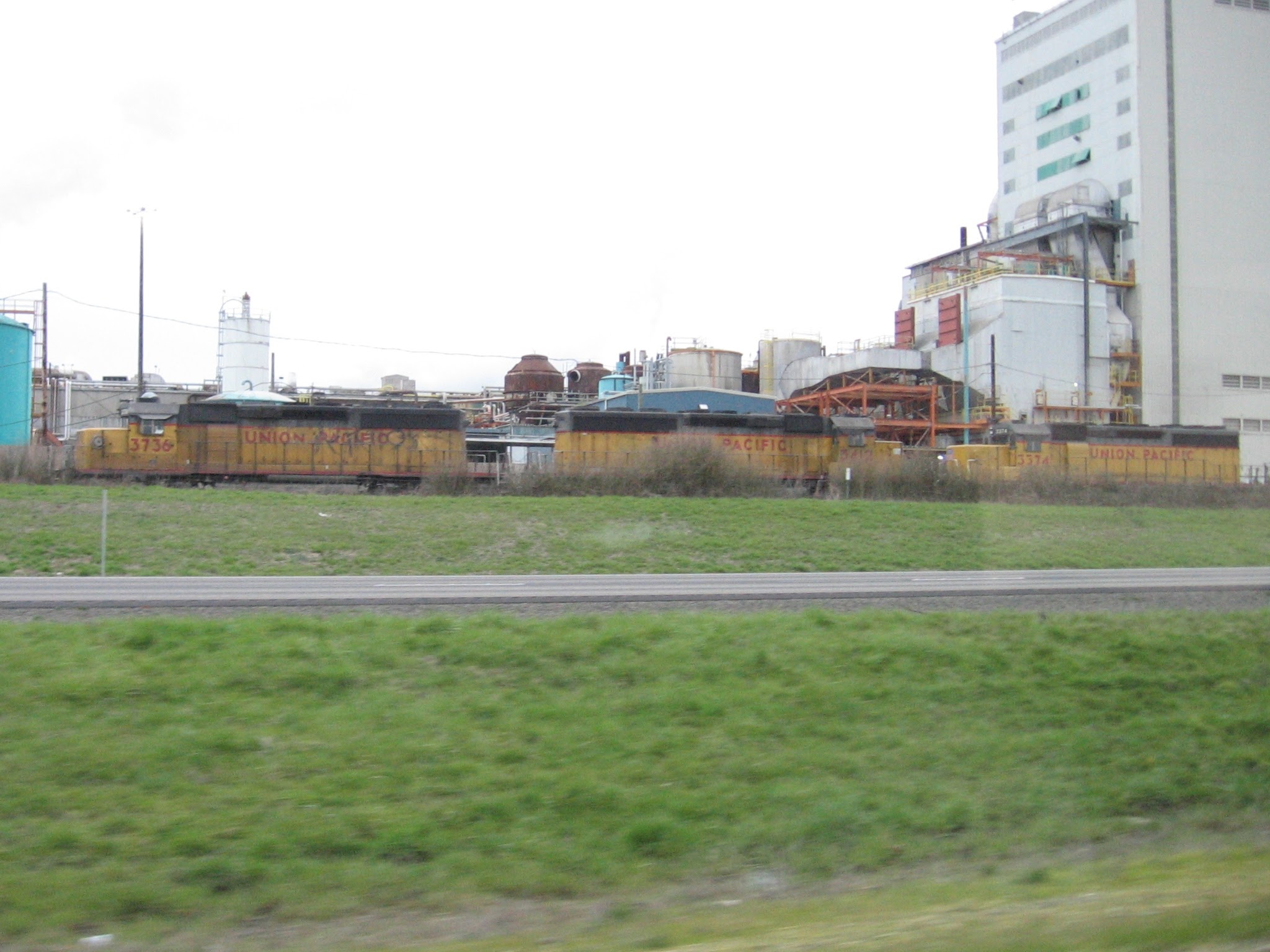
Freight Train at Albany, Oregon, on March 20, 2006

Freight Train at Albany, Oregon, on March 20, 2006

From my car on Interstate 5 at Albany, Oregon, on March 20, 2006, I photographed this Union Pacific freight train led by three 3,000-horsepower SD40-2s built by the Electro-Motive Division of General Motors. Leading the train, Union Pacific #3736 was built in February 1980. The second unit, Union Pacific #3412, was built in March 1978. The third unit, Union Pacific #3374, was built in April 1977.