Friday, May 2, 2014

Farewell is not Forever - Part 5: PRPX #9477

IMG_2117 PRPX #9477

The first car in the train is #700's crew car, PRPX #9477. This car was originally built by the Pullman-Standard Car Company in 1948 as a 22 Section Sleeping Car for the New York Central Railroad. It was originally named Great Peconic Bay, and carried the number 10442.

IMG_2141 PRPX #9477

The car was sold to the Canadian National Railway in 1958, becoming CN #2063 and was renamed Valjean. in 1973, it was rebuilt into its current configuration as a baggage-dormitory car (a sleeping car for crewmembers) and renumbered to 9477. It still wears the colors of VIA (the Canadian equivalent of Amtrak) from when it was retired in 1990.

IMG_2118 PRPX #9477

This car appeared in the 1991 television episode Blind Faith of the Sixth Season of MacGyver and is featured in a scene where MacGyver (played by Richard Dean Anderson) must retrieve a video tape hidden in the car by an accomplice while avoiding two thugs. Scenes of the car in the episode are shown below.

IMG_2703 MacGyver on car #9477

IMG_2699 MacGyver on car #9477

IMG_2700 MacGyver on car #9477

IMG_2701 MacGyver on car #9477

IMG_2702 MacGyver on car #9477

IMG_2697 MacGyver on car #9477

IMG_2698 MacGyver on car #9477

After being sold by VIA, the car was stored by an individual in Mineral, Washington until 2003, when the PRPA purchased it for use as a crew car. All but two of the roomettes have been removed by the PRPA.

Continue to GN #1210 Plum Creek

Farewell is not Forever - Part 4: Oaks Amusement Park

In 1905, the Oregon Water Power & Railway Company built Oaks Amusement Park as a reason for Portland-area residents to use the interurban line on the weekends. Oaks Park opened on May 30, 1905. In the early 1920s, the operating company for the park was sold to John Cordary, a manager of the park. In the spring of 1925, park superintendent Edward H. Bollinger purchased the operating company from Cordary's widow shortly after Cordary's death. Bollinger purchased the park property itself from the Portland Electric Power Company in 1943. The park was passed on to Bollinger's son, Robert E. Bollinger, in 1949, and the younger Bollinger continued to operate the park until January 1, 1985, when he donated the park to a non-profit corporation he formed to run the park. Today, Oaks Park is one of the oldest continuously-operating amusement parks in the United States. Though the amusement park rides only operate in the summer and on weekends in the spring and fall, the roller-skating rink is open year-round.

IMG_2155 Oaks Park Entrance
Oaks Amusement Park Entrance.

This is the main entrance to Oaks Park.

IMG_2174 Oaks Park Roller Rink Entrance
Entrance at Oaks Park Roller Skating Rink.

This entrance is adjacent to the Roller Skating Rink at the north end of the park.

IMG_2173 Oaks Park Roller Rink
Oaks Park Roller Skating Rink.

The Oaks Park Roller Skating Rink opened in 1905, and is the oldest continuously operating roller rink in the United States. When the rink first opened, music was provided by a live brass band, accompanied by a Wurlitzer organ. The original Wurlitzer was replaced in the early 1920s by a William Wood console organ. This organ was expanded over the years until 1955, when it was replaced by the 1926 Mighty Wurlitzer from Portland's Broadway Theatre. This organ remains in use in the rink today. The organ features 1,242 pipes, 2,525 magnets, 4,700 pouches and 500,000 feet of wire. It was installed in the rink without shutters to make it loud enough to be heard over the skaters.

IMG_2175 Oaks Park Roller Rink
Oaks Park Roller Skating Rink.

The rink's floor measures 100 feet by 200 feet. After a flood in 1948 severely warped the rink's wood floor, the rebuilt floor was designed to float in the event of another flood. Since then, the floating floor has survived two serious floods, in 1964 and 1996. The large painted advertisement on the back of the rink building dates from at least 1948.

IMG_2156 Oaks Park Dance Pavilion
Oaks Park Historic Dance Pavilion.

The Historic Dance Pavilion is the only other original feature of the park. It can be rented out for wedding receptions and other special events.

IMG_2161 Oaks Park Totem Pole
Oaks Park Totem Pole.

This large totem pole stands near the picnic area and the Dance Pavilion, inside the train's loop.

IMG_2158 Oaks Park Miniature Train Ride
Oaks Park Miniature Train Ride.

Oaks Park has had a miniature train ride since its earliest days. The first miniature train was a steam-powered train built in 1910. It proved to be underpowered and was replaced in 1925. This is the fifth train Oaks Park has had.

IMG_2159 Oaks Park Miniature Train Ride
Oaks Park Miniature Train Ride.

This train replaced a Miniature Train & Railroad Company G-16 that was installed in 1956. The G-16 ran on 16" gauge track, and resembled a diesel locomotive, painted in the colors of the Union Pacific Railroad. The track is dual-gauge: 16" for the former train and 24" for the current one.

IMG_2160 Oaks Park Miniature Train Ride
Oaks Park Miniature Train Ride.

The train operates on a 2,600 foot oval-shaped loop that encircles the picnic areas. The train also passes by the Historic Dance Pavilion and runs alongside the Willamette River for nearly half its run. The ride is short; a single trip around the loop only takes a few minutes, though children might get bored if it were much longer.

IMG_2163 Oaks Park Miniature Train Ride
Oaks Park Miniature Train Ride.

The current train was built by the Chance Manufacturing Company of Wichita, Kansas. Chance is a famous manufacturer of amusement park rides. They have been manufacturing this train for many years, and continue to do so.

IMG_2162 Oaks Park Miniature Train Ride
Oaks Park Miniature Train Ride.

Though it looks like a steam locomotive, the train is actually powered by a gasoline engine. This train was originally used at Seattle's Woodlawn Park Zoo and was removed from the zoo in 1980.

IMG_7413 Oaks Park C.P. Huntington Button
Oaks Park “C.P. Huntington” Button.

Oregon Historical Quarterly claims that this train began operating at Oaks Park in 1985, but the button at left indicates it was dedicated on May 17, 1981.

CPRR 1 March 1992
The C.P. Huntington at the California State Railroad Museum.

The Chance locomotive is a miniature replica of the C.P. Huntington, a steam locomotive on display at the California State Railroad Museum in Sacramento. The real C.P. Huntington was built by Danforth, Cooke & Company of Paterson, New Jersey in 1863 for the Central Pacific Railway of California. It was delivered to San Francisco on March 19, 1864, after traveling by sea from New York around Cape Horn. The C.P. Huntington was used for special occasions after 1894, and was donated to the state of California by Central Pacific's successor, Southern Pacific in 1964. The C.P. Huntington is named for Collis Potter Huntington, one of the original founding officers of the Central Pacific, the railroad that built from California to create the first Transcontinental Railroad with the Union Pacific in 1869.

IMG_2171 Oaks Park Skooter Cars
Oaks Park Skooter Cars.

One of the most popular rides at Oaks Park has always been the Skooter Cars, though they are often referred to by the more generic term: bumper cars.

IMG_2172 Oaks Park Skooter Cars
Oaks Park Skooter Cars.

The Skooter Cars were most likely manufactured by Lusse Brothers, Inc.

IMG_2167 Oaks Park Carrousel
Oaks Park Carrousel.

The Carrousel is the oldest ride in the park. It is a Herschell-Spillman "Noah's Ark" built in 1912. It was placed in Oaks Park in 1924. It the the only part of Oaks Park listed on the National Register of Historic Places. Notice the neon sign that reads "CARROUSEL." I have seen references online to this sign being misspelled, however according to the 1962 American College Dictionary, the definition of the word "carrousel" is "n. 1. a merry-go-round (def. 1).  2. a tournament in which horsemen executed various formations. Also, carousel." The definition of the word "carousel" on the other hand is simply "n. carrousel." So, "carrousel" is the original word and the proper spelling, although "carousel" is an acceptable alternate spelling. Interesting that it now seems to be the primary spelling.

IMG_2169 Oaks Park Carrousel
Oaks Park Carrousel.

I think it is also interesting that a carrousel takes its name from the horses, not the rotation. (If you are curious, the definition of "merry-go-round" is "n. 1. a revolving machine, as a circular platform fitted with hobby-horses, etc., on which persons, esp. children, ride for amusement.  2. any whirl or rapid round.")

IMG_2176 Oaks Park Ferris Wheel
Oaks Park Ferris Wheel.

This Ferris Wheel was built by the Eli Bridge Company. It is an Eagle Rim Drive Wheel.

IMG_2165 Oaks Park Looping Thunder
Oaks Park Looping Thunder Roller Coaster.

There have been many roller coasters at Oaks Park over the years. This is the Looping Thunder. It is a Looping Star model built by Fratelli Pinfari S.r.l of Montova, Italy. It has been at Oaks Park since 1996. The track is 1,197 feet 6 inches long. At it's highest point the coaster is 36 feet high.

IMG_2166 Oaks Park Tilt-A-Whirl
Oaks Park Tilt-A-Whirl.

Here is the classic Tilt-A-Whirl, built by Sellner Manufacturing.

IMG_2168 Oaks Park Rock & Roll
Oaks Park Rock & Roll Ride.

The Rock & Roll is a Matterhorn-style ride made by Bertazzon.

IMG_2170 Oaks Park Big Pink Slide
Oaks Park Big Pink Slide.

Big Pink is a Dartron slide. It was added to Oaks Park  in the 1990s with great fanfare.

Oaks Park Links:
The Oaks in the Progressive Era
Oaks Park at PdxHistory

Continue to PRPX #9477

Farewell is not Forever - Part 3: History of the Route

The tracks #700 would be running on were originally laid in the early 1890s by the East Side Railway Company. The East Side Railway Company was formed in 1891 to link Portland to Oregon City. This line, completed in 1893, was the first interurban railroad in the United States, and utilized the first long-distance transmission of electricity. The East Side Railway became the Portland City & Oregon Railway in 1901, and was renamed the Oregon Water Power & Railway Company in 1902.

The Oregon Water Power & Railway Company consolidated with the Portland Railway streetcar company in 1906 to become the Portland Railway, Light & Power Company. The PRL&P became the Portland Electric Power Company (PEPCO) in 1924.  By 1946, the streetcar lines had become the Portland Traction Company and the interurban lines were the Portland Railroad and Terminal Division of the Portland Traction Company. Streetcars stopped operating in 1950, and the electric interurbans stopped running in January of 1958. Freight service continued on this line with the Portland Traction Company's two EMD SW1 diesel locomotives, #100 & #200, which were purchased new in February 1952 and March 1953 respectively.

Portland Traction Company SW1 #100 at Union Station in Portland, Oregon on May 11, 1996
Portland Traction #100 at Union Station, May 11, 1996.

In 1962, the Portland Traction Company was purchased jointly by the Union Pacific and Southern Pacific railroads. Portions of the line would be abandoned over the next 30 years, until 1991, when all that remained was the four miles from East Portland to Milwaukie, which were sold to Dick Samuels along with SW1 #100 to become the East Portland Traction Company. It was these very tracks that #700 was pulled down when she was placed in Oaks Park in 1958, and when she was taken back out to be restored. SW1 #200 was sold and ended up serving a grain elevator in Superior, WI. The original 17 miles of the Springwater Trail opened in 1996, mostly on the right of way of the old Portland Traction line to Boring.

See The Rise and Fall of the Portland Traction Company by Craig Bass for more history, and see Brian McCamish's Springwater Division and Oregon Pacific to see what is left.

Oregon Pacific Railroad SW8 #803 in Liberal, Oregon in September 1998
Oregon Pacific #803 at Liberal, Oregon, September 1998.

Dick Samuels merged the East Portland Traction Company with his Molalla Western Railroad in 1997 to form the Oregon Pacific Railroad. Portland Traction #100 is still maintained in its original orange paint, though it is only one of several locomotives operated by the Oregon Pacific. In the 1990s, Dick Samuels started a small excursion train called SamTrak on this route between Oaks Park and OMSI. Though SamTrak service was suspended in 2002, the SamTrak station at Oaks Park remains. Though these tracks are usually regulated to freight-only service now, they do occasionally host excursions for #700 and #4449, especially during the holidays.

IMG_2091 SamTrak Oaks Park Station
SamTrak Oaks Park Station

There were once two parallel railroad tracks along this route. The track further from the Willamette River was removed years ago. When the city of Portland wanted to build the Springwater bike trail, the remaining track was moved into the position of the track that had been removed, to allow the trail to be closer to the river. This part of the trail opened in November 2002. The entire Springwater Trail is now just over 20 miles long.

Continue to Oaks Amusement Park

Farewell is not Forever - Part 2: History of the SP&S #700

IMG_2113 SP&S #700
Spokane, Portland & Seattle #700 at Oaks Park.

The Spokane, Portland & Seattle Railway, known as The Northwest's Own Railway, was formed in 1905 as a joint venture between the Great Northern and Northern Pacific Railways to build a railroad connecting the cities of Spokane and Pasco, Washington with Portland, Oregon via the north bank of the Columbia River.

IMG_2116 SP&S #700 Herald
Spokane, Portland & Seattle herald on #700’s tender.

The SP&S would find itself stuck with retired equipment from its parent roads, and by the mid-1930s, the SP&S was finding it difficult to compete with the Union Pacific Railroad on the Oregon side of the river.
IMG_2108 SP&S #700
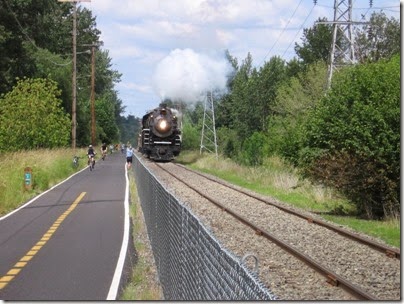
Spokane, Portland & Seattle #700 at Oaks Park.

Finally, the GN and NP gave the SP&S some new locomotives of its own, in the form of six 4-6-6-4 Challengers for freight service and three 4-8-4 Northerns for passenger service. These locomotives were identical to locomotives then being delivered to Northern Pacific, except that the SP&S locomotives would burn oil instead of coal.
IMG_2112 SP&S #700
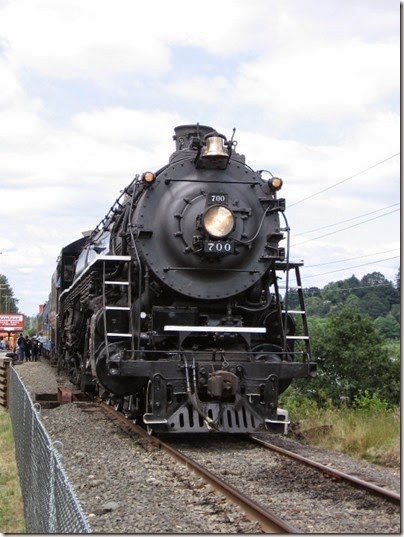
Spokane, Portland & Seattle #700 at Oaks Park.

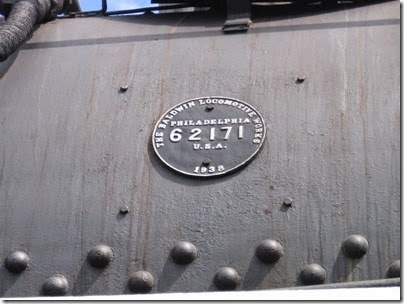
The three passenger locomotives were numbered 700-702. They were built by the Baldwin Locomotive Works of Philadelphia, Pennsylvania in June, 1938. Except for burning oil, they were identical to the Northern Pacific A-3 class of locomotives. SP&S referred to them as E-1's.
IMG_2115 SP&S #700
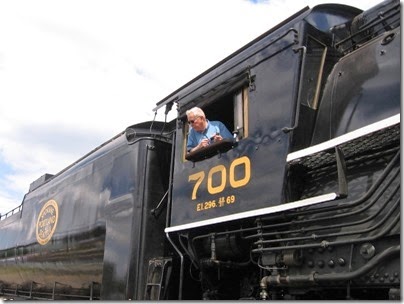
Engineer looking down from the cab of SP&S #700.

Here are some specifications for the SP&S #700:

Builder Baldwin Locomotive Works, Philadelphia, PA
Builder Number 62171
Class & Wheel Arrangement E-1 4-8-4 Northern
Delivered June 1938
Horsepower 5,000+
Tractive Effort 69,800 pounds
Steam Pressure 260 pounds per square inch
Cylinder Diameter 28 inches
Cylinder Stroke 31 inches
Valve Diameter 14 inches
Valve Stroke 8 inches
Driving Wheel Diameter 77 inches
Overall Height 16 feet, 10 13/16 inches
Length of Engine & Tender 110 feet, 6 3/4 inches
Weight of Engine & Tender 879,700 pounds
Weight of Engine 485,820 pounds
Weight on Drivers 296,500 pounds
Weight of Tender (Loaded) 379,700 pounds
Water Capacity of Tender 22,000 gallons
Fuel Oil Capacity of Tender 6,000 gallons

IMG_2114 SP&S #700 Builders Plate
Spokane, Portland & Seattle #700’s builder’s plate.

By 1955, the SP&S had completed dieselization and was ready to retire the last of its steam locomotives. The SP&S would make sure that steam would go out in style, though. On May 20, 1956, SP&S sponsored the Farewell to Steam Excursion, a 21-car round trip between Portland, Oregon and Wishram, Washington behind the SP&S's steam locomotive #700. 1,400 passenger rode behind #700 for what everyone believed would be the last time.

IMG_2119 SP&S #700
Spokane, Portland & Seattle #700 at Oaks Park.

After the excursion, #700 joined the rest of SP&S's steam locomotives in a scrap line. The end seemed certain, until the Union Pacific offered the City of Portland a retired steam locomotive of its own to display in a park: 4-6-2 Pacific #3203, originally built by Baldwin in 1905 as the Oregon Railroad & Navigation Company #197.

OWRN 197 August 2002
OR&N #197 in the Brooklyn Roundhouse in August 2002.

Not to be outdone by its competitor, the SP&S decided to donate a newer and larger locomotive to the City of Portland: #700. The locomotive was donated to the city on January 13, 1958, and would be the only SP&S or NP E-1 Northern to survive. The two locomotives were placed on display in Oaks Park that year, and were soon joined by another 4-8-4: Southern Pacific #4449.

SP 4449-2 June 7 1997
SP #4449 in Wishram, Washington on June 7, 1997.

Historical Photo:
SP #4449, SP&S #700 & UP #3203 at Oaks Park during 1964 flood (Friends of SP 4449)

IMG_2136 SP&S #700
Spokane, Portland & Seattle #700 at Oaks Park.

Only one other SP&S steam locomotive would escape the scrap line. O-3 Class 2-8-2 Mikado #539, built by the Brooks Locomotive Works as Northern Pacific 1762 in September, 1917 and transferred to SP&S in August, 1944, was donated to the City of Vancouver, Washington on October 4, 1957. In June 1997, it was moved to Battle Ground, Washington for restoration, and in 2007 went to the Grand Canyon Railway.
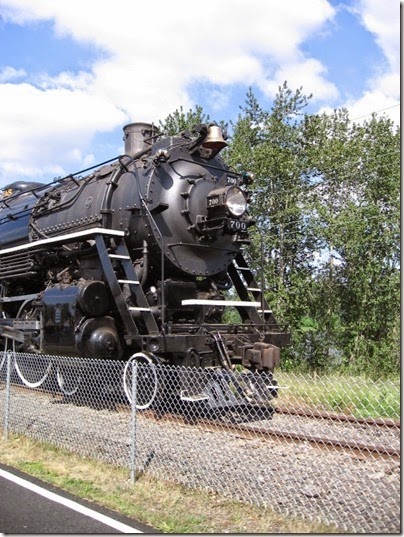
IMG_2137 SP&S #700
Spokane, Portland & Seattle #700 at Oaks Park.

In an interesting twist, the SP&S promised a steam locomotive to Klickitat County, Washington to be placed in Maryhill State Park, only to have already scrapped all of its own remaining steam locomotives. SP&S purchased retired Great Northern P-2 Class 4-8-2 Mountain #2507, repainted it in SP&S colors, and donated the "SP&S" locomotive. The SP&S never actually operated any 4-8-2 Mountain-type locomotives. The locomotive was eventually repainted back into Great Northern colors, and is now on display in Wishram, Washington, ironically right next to the former SP&S main line.

IMG_2138 SP&S #700
Spokane, Portland & Seattle #700 at Oaks Park.

The Spokane, Portland & Seattle Railway itself disappeared in 1970 as it merged into the Burlington Northern Railroad, now Burlington Northern Santa Fe, or BNSF.

IMG_2139 SP&S #700
Spokane, Portland & Seattle #700 at Oaks Park.

The three locomotives in Oaks Park remained there behind a chain-link fence for a number of years. SP #4449 was the first to be removed. It would pull the American Freedom Train in 1975-76.
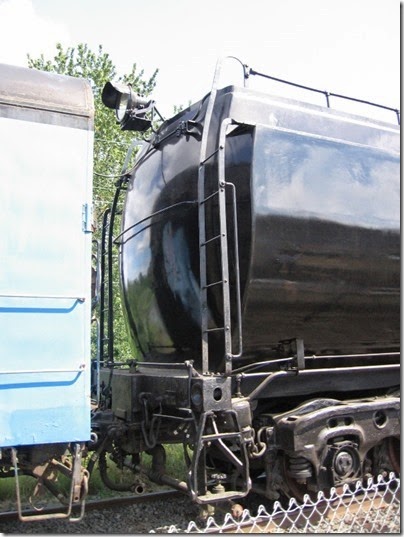
IMG_2142 SP&S #700 Tender
Spokane, Portland & Seattle #700’s tender at Oaks Park.

After #4449's restoration, 15-year-old Chris McLarney founded the Pacific Railroad Preservation Association in 1977 to restore #700. The locomotive returned to operation in 1990.

IMG_2154 PRPA Sign
Sign with the Pacific Railroad Preservation Association’s logo.

The third locomotive, UP #3203, has also been removed from Oaks Park to be restored as OR&N #197.

IMG_2153 SP&S #700
Spokane, Portland & Seattle #700 at Oaks Park.

Since its restoration, #700 has been in operation throughout the Pacific Northwest, operating around the Portland area and the Willamette Valley, returning to its own route on the north bank of the Columbia River, and even traveling as far as Montana, where it never visited in its years of regular service for the SP&S.
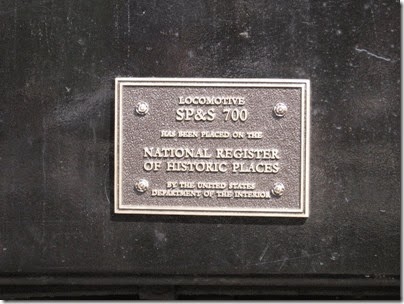
IMG_2140 SP&S #700 National Register of Historic Places
National Register of Historic Places plaque.

On January 25, 2006, it was placed on the National Register of Historic Places. It is the third largest and second most powerful operating steam locomotive in the world.

IMG_2152 SP&S #700
Spokane, Portland & Seattle #700 at Oaks Park.

The year 2006 was special, as it marked 50 years since everyone said farewell to #700, thinking she was doomed to be scrapped, and yet she has been resurrected; she still pulls passengers long after the diesels that replaced her had themselves been replaced and retired. An excursion was in order.

IMG_2177 SP&S #700
Spokane, Portland & Seattle #700 at Oaks Park.

Continue to History of the Route

Farewell is not Forever - Part 1

The 50th Anniversary of the Farewell to Steam Excursion featuring the Springwater Trail, Oaks Park & SP&S #700

(NOTE: This website is NOT affiliated with SP&S #700; visit www.sps700.org for current info)

I originally posted Farewell is not Forever on my website on July 20, 2006.

Farewell

On May 20, 1956, the Spokane, Portland & Seattle steam locomotive #700 pulled a special train to mark the final run of all SP&S steam locomotives. It was called the Farewell to Steam Excursion. But, it wasn't really the end for #700. On June 10-11, 2006, #700 ran $5 round-trips from Oaks Park north along the Springwater Trail to near the Oregon Museum of Science & Industry, in commemoration of the 50th anniversary of the 1956 Farewell to Steam Excursion. I was there on June 10 to ride the train and witness the event.

Here is a list of the following posts about this event:

History of the SP&S #700
History of the Route
Oaks Amusement Park
PRPX #9477
GN #1210 Plum Creek
SamTrak Caboose #900
Speeders
Santa Fe Speeder
Valley & Siletz Speeder
P&M Speeder 03
Milwaukee Speeder #7849
Spirit of Toledo Speeder
Speeder #7927
Union Pacific Speeder #2615
SCL Speeder RI-040
Rio Grande Speeder
Fairmont Speeder
Riding the Train
The Other End of the Line
Passenger Cars
Milwaukee Road Parlor Car
Milwaukee Road Baggage-Dorm
Milwaukee Road Coach
SP&S Sleeper #366 Portland
Conclusion

Farewell to Steam 50th Anniversary Links:
Spokane, Portland & Seattle #700
Brian McCamish's -50th Anniversary- Farewell to Steam
Oaks Amusement Park

Continue to History of the SP&S #700